
The True Cost of FOMO: How to Protect Your Portfolio from the Illusion of Easy Money

Investing should be a rational act. And yet, throughout history, human behavior in the markets has been anything but. Greed and fear alternate like tides, and today, one of the most dangerous emotional triggers for investors goes by a modern acronym: FOMO, the Fear of Missing Out. It’s a timeless instinct, but in today’s hyper-digital environment, it has evolved into a subtle but powerful threat—one that can turn even the most cautious saver into an unsuspecting victim.

What FOMO Really Means in Investing

FOMO in investing is the emotional urge to act quickly for fear of missing out on a supposedly unrepeatable opportunity. It’s not driven by financial analysis or macroeconomic outlooks—it’s sparked by rising charts, euphoric online chatter, and the feeling that everyone else is cashing in on something huge.

Platforms like Reddit, X, TikTok, and YouTube amplify this sensation. Seeing others seemingly profit in real time, while you sit on the sidelines, creates anxiety. And the only thing that seems to soothe it? Acting—buying now—before it’s too late.

The Perfect Environment for Fear of Being Left Behind

Never before has information moved faster than our ability to process it. Social platforms turn every opinion into a trend, every rumor into a headline, every stock into a once-in-a-lifetime opportunity. The result? A marketplace driven more by noise than knowledge, where the loudest voice often wins, regardless of substance.

Accessing markets no longer requires a broker or financial advisor. All it takes is a smartphone and a debit card. While this has democratized investing, it has also left many without the tools—or the discipline—to navigate complexity and volatility.

How FOMO Can Damage Your Portfolio

FOMO distorts investment behavior in several dangerous ways:

  • It leads people to buy into already-overpriced assets, fueling speculative bubbles.
  • It causes portfolios to become dangerously concentrated in a few high-flying names.
  • It encourages frequent, impulsive changes to investment strategy—often at the worst times.

The numbers tell a hard truth: those who chase trends or try to time the market tend to underperform long-term investors with patience and discipline. The history of finance is filled with cautionary tales—GameStop, AMC, Dogecoin, or even various tech and green stocks driven by hype rather than fundamentals.

When GameStop Becomes a Case Study

In January 2021, GameStop went from struggling retailer to stock market sensation. Online communities like WallStreetBets orchestrated a coordinated buying spree, driving the price from a few dollars to over $120 in a matter of weeks. But those who bought at the top quickly watched their gains evaporate when the price fell back down.

GameStop wasn’t an isolated case—it was a pattern. The same dynamics repeated with different names, always ending the same way: with the last ones in holding the bag.

Who’s Most Affected by Financial FOMO?

New, young investors. People with little financial education. Users deeply immersed in social media. These groups are particularly vulnerable to FOMO.

Why? Because FOMO doesn’t just play on greed—it feeds on the need for social validation. In a world where likes, followers, and stories of success are currency, not participating in the latest trend feels like failure. Add to this the classic herd mentality—the more people do something, the more it seems like the right move—and you’ve got a recipe for collective irrationality.

How to Defend Yourself Against FOMO in Investing

1. Recognize the Problem

First, acknowledge that FOMO is real—and dangerous. Learn to filter the noise and separate entertainment from actual investment insight.

2. Commit to Ongoing, Multidisciplinary Learning

Successful investors study markets, industries, and company fundamentals. But they also study human psychology. Knowing your emotional triggers is half the battle.

3. Set Clear, Non-Negotiable Rules

Discipline protects you from yourself. Some useful guidelines:

  • Never invest more than 5% of your portfolio in a single stock.
  • Maintain diversification across asset classes.
  • Avoid making decisions based solely on unsolicited advice or internet hype.

4. Respect the Value of Time

A good investment idea today will still be good next week. If it only works in the heat of the moment, it’s not an investment—it’s a gamble.

5. Cool Down Your Emotions

Some investors implement mandatory reflection periods—three days, a week, even a month—before executing high-risk trades. Time helps enthusiasm settle and logic resurface.

Not Everything That Goes Up Is Built to Last

History teaches us that bubbles are eternal, even if the packaging changes. From the Dutch tulip mania in the 1600s to the dot-com boom of the 1990s, every generation has chased irrational dreams—and paid the price.

Social media has sped up these cycles, but it hasn’t changed their nature. Ultimately, true investments generate value over time, not overnight.

The Patient Investor Always Wins

Those who build solid financial plans—rooted in long-term goals and clear strategies—are less likely to get swept away by passing trends. Not because they’re resistant to change, but because they know where they’re going.

Patience, in investing, is a competitive advantage. The market rewards those who resist temptation, who are willing to let go of today’s hype in favor of tomorrow’s real returns.

Conclusion

Markets will always be full of noise. Full of voices promising easy money, quick wins, and massive upside—if only you act now. Resisting these siren calls takes mental strength and clarity of purpose.

FOMO is the perfect trap for those seeking thrills, not results. But investing isn’t an adrenaline rush—it’s a marathon. And those who remember that, especially when the crowd runs the other way, gain an edge no algorithm or viral trend can ever replicate.
Long-Term Investing: What Does “Long-Term” Really Mean?

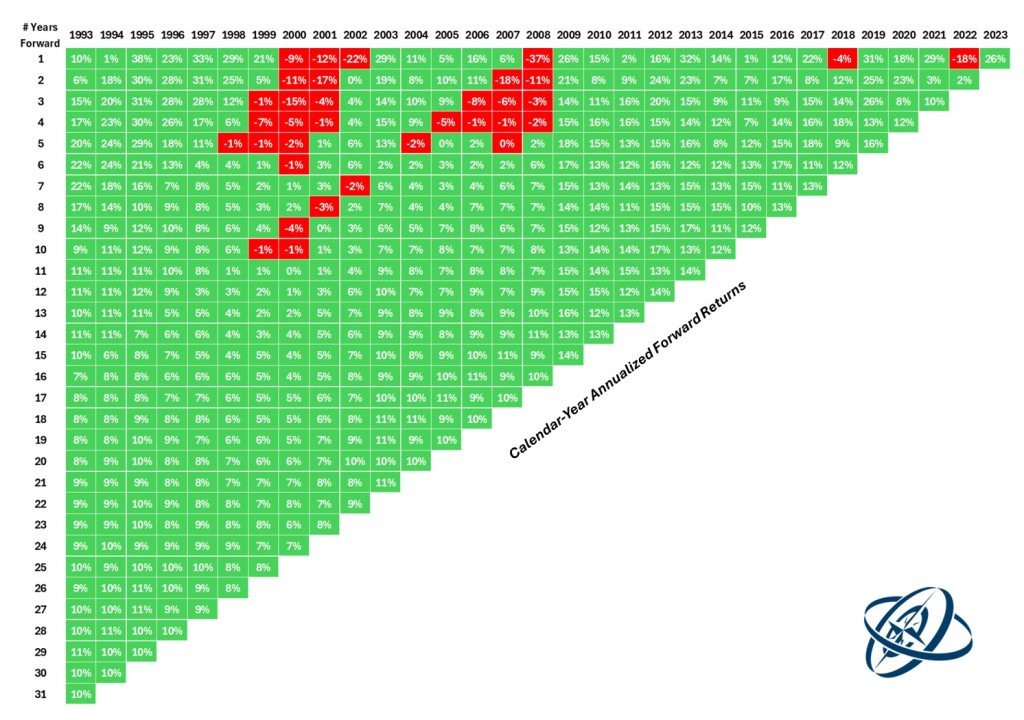
One of the most insightful graphs for anyone interested in investing shows the annualized returns of the S&P 500 from various starting points. It acts as a time map, revealing year-by-year what would have happened to your capital if you had invested at a given point and left your money to grow for 1, 3, 5, 10, or 20 years. It’s a vivid snapshot of just how crucial time is in the world of investing.

Let’s take an example: If you had started investing in 2005, you would have achieved an average annual return of 3% after six years and 8% after ten years. These numbers tell different stories depending on your perspective: a weak decade or one defined by resilience. What stands out, however, is the dominance of green on the graph. In the vast majority of cases, the longer you invest, the better the returns. This isn’t just a motivational slogan—it’s the proven strength of the stock market over time.

When Does “Long-Term” Really Become Long-Term?

In financial theory, 10 years are often considered “long-term”. But in real life, 10 years can feel like a lifetime. It’s the time that separates a thirty-year-old from a forty-year-old, a recent graduate from a seasoned professional, or someone without children from a parent. In a decade, everything can change. Yet, in finance, 10 years might not be enough.

The stock market can be brutal in the short term. There have been periods over the past century where even the world’s most renowned index, the S&P 500, delivered negative or almost zero returns. Anyone who invested everything at the wrong time and endured two consecutive crashes would have seen their investments suffer greatly. However, looking beyond 15 years, there has never been a period in modern history where the returns were negative.

Over 20 years, the annual return of the S&P 500 has always ranged from 6% to 10%. In other words: the risk of loss diminishes with time, and so does the anxiety over entering the market at the “wrong” moment.

Time Matters Much More Than Timing

Many investors, especially at the start, obsess over “when to enter.” They wait for a market crash, fear a peak, and analyze charts as if they hold prophetic power. But when the time horizon is long, the exact moment you enter matters far less than how long you remain invested.

For instance, the worst annual return in one year was -37%, and the best was +38%. Over five years, the range tightens to -2% versus +18% annually. After ten years, it spans from -1% to +17%. After twenty years, all the returns are positive.

This tells us that the most important factor isn’t the day you invest, but how long you stay invested.

You Don’t Need Exorbitant Returns

An often-overlooked aspect of investing is that not everyone needs to chase high returns. The goal isn’t to outperform the market but to achieve your financial goals while minimizing stress and effort.

For example, if you have €100,000 and need it for a trip or another short-term goal, investing in a money market ETF offering around 3.5% per year is perfectly sufficient. Secure and stable.

On the other hand, if you have €1,000,000 and are aiming for a steady income, a modest 4% return would generate €40,000 annually—enough to cover a comfortable standard of living without major surprises.

But if you’re young, with low initial capital, high saving potential, and a long time horizon (20-30 years), accepting volatility and investing primarily in stocks makes sense. It’s in these years that returns accumulate, and time becomes your best ally.

The Secret? Planning

Good financial planning isn’t just about plugging a 7% return into a compound interest calculator and seeing how much you’ll have in 30 years. It’s about asking yourself:

  • What returns do I really need?
  • When will I need the money?
  • How much volatility can I tolerate without losing sleep?
  • Can I afford to “forget” about this investment for 15 years?

The answers to these questions will guide your decisions: asset allocation, time horizon, and the right instruments for your goals.


Conclusion

The stock market remains the cornerstone for long-term investors. However, the definition of “long-term” is subjective and depends on personal circumstances. For some, it’s 10 years, for others 30. What matters most is understanding where you are in your life’s journey and adjusting your strategy accordingly.

Rather than striving for the perfect market entry, focus on finding the right balance between time, goals, and peace of mind.

3 Truths About Investing You Should Remember (Especially on the Worst Days)

We live in an era where access to financial markets has never been easier or more democratic. And yet, fear still dominates the decisions of many investors—or worse, those who avoid investing altogether.

You don’t need complex formulas or crystal-ball predictions to navigate this world. Sometimes, just three simple data points can radically shift your perspective. Not only do they show what the market has done—they also reflect how human behavior reacts to it.

Here are three essential truths every investor should write down and revisit—especially when the skies look darkest.

1. The Market Is Positive More Often Than You Think

Over the past 25 years, the U.S. stock market (S&P 500) ended the year in the green 17 out of 25 times. That’s 68% of the time.

Put another way: nearly 7 out of every 10 years delivered a positive return.

So why does it always feel like a crash is looming?

Because the human mind is wired to remember pain more vividly than peace. Crashes, shocks, and losses make noise. Gains? They happen quietly.

This leads to a distorted perception of reality.

Investing is counterintuitive: you often need the courage to stay the course exactly when every instinct tells you to run.

2. Even in Winning Years, There Were Sharp Drops

Here’s the more surprising truth: even in most of those positive years, the market experienced temporary declines of 5–10%, and in some cases even 20% or more.

Yet those dips did not stop the market from finishing the year in profit.

This is a misunderstood concept: volatility isn’t the price of admission—it’s the nature of the ride.

Some see a temporary -10% drop and think, “I need to sell before it gets worse.” Others recognize it as a normal part of the journey—and maybe even an opportunity to invest more.

3. Long-Term Investors Have Been Rewarded—Despite Everything

From 1999 to 2024, the world went through:

  • The dot-com bubble,
  • The 2008 global financial crisis,
  • The 2020 pandemic,
  • Not to mention Brexit, wars, European debt crises, and more.

Yet, an investor who put $100,000 into the S&P 500 at the start of that period would now have $666,300with dividends reinvested.

That’s a total return of +566%, or an annualized return of 7.85%.

A performance that no savings account or government bond could even come close to matching.

But This Is Not a Magic Formula to Get Rich

These numbers are not guarantees.

They do not mean that:

  • The next 25 years will necessarily look the same;
  • Everyone should put all their savings into the S&P 500;
  • It’s easy to stay invested during the worst moments.

The truth is, investing isn’t just math. It’s psychology.

Knowing the market has rewarded patience is helpful—but staying the course when everything feels like it’s falling apart is what really sets successful investors apart.

Final Thought: Three Stats, One Clear Message

The data tells a simple, powerful story: the market rewards patience, consistency, and knowledge.

Investing is not gambling. It’s not about “timing the market.” It’s about embracing time, volatility, and even discomfort.

Those who can do this often look back and realize that the crises which once felt terrifying were merely part of the journey toward a better financial future.

An Extra 1% Every Year: How a Small Increase in Investments Can Lead to Incredible Results

Imagine you had the opportunity to increase just 1% the percentage of your salary you save or invest each year. It might seem like a trivial change, right? Yet, by applying this simple adjustment over several years, the results could be astonishing. Thanks to compound interest, even the smallest percentage increase can make a huge difference in the long run.

A Concrete Example: The Power of 1% Annually

Let’s assume you decide to save 10% of your salary every year and invest this amount in a portfolio that offers a 5% annual return. If you maintain this consistent savings rate for 30 years, the amount you accumulate will be impressive.

  • Year 1: Save $1,000.
  • Subsequent years: Each year, you earn a 5% return on your investments.

At the end of the 30 years, you’ll have accumulated approximately $100,000 due to this consistent saving. But now, let’s imagine what would happen if you decided to increase the percentage of your savings by a modest 1% each year. Starting from the initial 10%, in the second year, you’d save 11%, in the third year 12%, and so on.

The Impact of an Additional 1% Each Year

Let’s consider that your savings rate starts at 10%, and you increase it by 1% every year (so, in the second year, you save 11%, in the third year 12%, and so on). If you apply this incremental increase each year for 30 years, the final amount won’t just be higher; it will also experience exponential growth due to compound interest.

  • Year 1: You save $1,000.
  • Year 2: You save $1,100 (1,000 + 10% of the previous year).
  • Year 3: You save $1,210 (11% of the previous year).

Continuing in this manner, over time, your capital grows significantly. Thanks to the annual increase of 1%, by the end of 30 years, you could have accumulated not just $100,000, but around $150,000 or more, depending on market conditions. This happens because you’re not only increasing the amount you save every year, but the interest on your savings is multiplying as the total sum you’re working with grows.

The Final Result: The Power of Consistency

What does this all mean? If you start saving and investing just 1% more each year, without even noticing it, your savings and investments will grow at a much faster rate. The key to all of this is compound interest: it’s not just about the money you save, but how that money grows over time thanks to the interest that compounds on itself. At first, the effect may seem slow, but as time passes, it becomes increasingly significant. A 1% annual increase may seem minimal, but the cumulative effect over 10, 20, or 30 years is incredible.

The Dynamics of Compound Interest

To better understand, you need to realize that compound interest is a process that sustains itself. Each year, the amount you’ve invested grows not just because of the money you’ve put aside, but also because of the interest added to your existing capital. In the beginning, the effect may be slow, but over time, it becomes more and more powerful. A 1% annual increase may seem negligible, but the cumulative effect on your savings over 10, 20, or 30 years is remarkable.

In conclusion, even a small increase like 1% can have an enormous impact over time. The key lies in consistency and patience: with compound interest, every small saving effort adds up and grows exponentially, leading to extraordinary results that you might not have imagined when you first started. Don’t underestimate the power of a small annual increase — over time, it will make a massive difference for your financial future.

Investing or Speculating? The Difference Between Trader and Investor

When it comes to financial markets, one of the most common questions that arises is: “Are you investing or speculating?” While this may seem like a trivial question, the answer is crucial to understanding not only the strategy you should adopt but also the risks you are taking. Many people use these terms interchangeably, but there are significant differences between investment and speculation, as well as between an investor and a trader.

In everyday language, it seems that the goal is always the same: making money. But if you don’t truly understand what you are doing when you put your capital into markets, you risk finding yourself in complicated situations, possibly losing a part, or even all, of your investment. So let’s dive deeper into what it means to invest versus speculate, and the differences between an investor and a trader.

Investment vs. Speculation: What’s the Difference?

Let’s start with the definitions of investing and speculating. Although both actions involve putting money into a financial asset with the intent of profiting, the way they are carried out is fundamentally different.

Investing means purchasing an asset with the expectation that, over the long term, it will either grow in value or generate cash flow, such as dividends from stocks, interest from bonds, or rental income from properties. The investment horizon is usually long-term, often spanning decades, and the goal is to build sustainable wealth. An investor focuses on the quality of the asset, looking for assets that can provide steady returns over time.

Speculating, on the other hand, involves purchasing an asset with the goal of selling it at a higher price in the short term. Speculation focuses on price fluctuations in the near term, and the profit does not come from the intrinsic value of the asset, but from market dynamics. A speculator and a trader are looking for quick market movements and trying to capitalize on those price shifts in a short period.

1. Time Horizon: Long-Term vs Short-Term

One of the key differences between investing and speculating is the time horizon. Investors typically focus on long-term goals, such as retirement or building generational wealth, and are willing to hold an asset for years, even decades, if necessary. Investing is about having patience and waiting for the asset’s value to grow over time.

In contrast, a speculator is focused on short-term goals. They want to see quick results, often within days, weeks, or a few months. Speculation is about taking advantage of rapid market movements. Speculators look to profit from temporary factors, such as company news, geopolitical events, or any other catalysts that might drive prices in a favorable direction over a short time frame.

2. Priorities: Capital Safety vs Return

Investors tend to prioritize the safety of their capital. Following the principles of Value Investing, they are more inclined to conduct in-depth research on the assets they invest in, evaluating intrinsic value and seeking assets that can produce consistent cash flows. Risk, for investors, is minimized through smart diversification and a defensive approach.

Speculators, on the other hand, are willing to take greater risks in exchange for quick and significant returns. If an investor cares about the long-term sustainability of their portfolio, a speculator focuses on maximizing returns in the short term, regardless of the underlying asset’s stability. Professional speculators, like traders, often use tools such as leverage to amplify gains, but this also exposes them to bigger losses.

3. Cash Flow vs. Price: What Really Matters?

Another critical aspect that differentiates investment from speculation is the type of return sought.

Investors focus on cash flows: dividends, interest payments, rental income. The idea behind investing is that an asset should be productive, generating income that justifies the invested capital. Even if the asset’s price fluctuates, the investor can still earn a return from the cash flow (such as dividends or interest payments), making the investment valid even during market downturns.

Speculators, by contrast, care almost exclusively about the price of the asset. Their attention is on market fluctuations and price movements rather than the inherent value of the asset itself. If an asset’s price declines, a speculator may choose to sell at a loss, betting on a quick price recovery. Here, cash flows matter less—what matters most is a rapid price increase.

4. Strategy: Diversification vs. Concentration

An investor’s strategy is typically diversified. They aim to minimize risk by spreading their investments across a broad portfolio of assets, which can include stocks, bonds, real estate, mutual funds, etc. The goal is to achieve steady, sustainable returns over time, reinvesting the profits back into the portfolio.

A speculator, on the other hand, adopts a concentrated strategy. Their focus is on a few select bets, carefully chosen, and followed with a meticulous, almost obsessive attention to detail, trying to extract maximum profit. The risk is greater, but the goal is to seize the right opportunity at the right moment.

5. Integrating Investment and Speculation

It is possible to integrate investment and speculation, but it must be done in a disciplined manner. The majority of investors should focus first on building a solid long-term investment strategy, using diversification and aiming for capital safety. Only a small portion of their capital should be dedicated to speculative activities, like attempting to profit from short-term market movements.

The biggest mistake a saver can make is confusing investing with speculating. Mixing the two can lead to devastating losses. Speculating without a clear strategy and proper risk management can result in a series of reckless bets that undermine your financial stability.

Conclusion: Understanding the Financial Markets Game

Investing and speculating are two distinct approaches to financial markets. The investor has a more defensive, long-term approach, aiming to build sustainable wealth over time. The speculator, on the other hand, plays a short-term game, trying to take advantage of price fluctuations for quick profits.

Understanding this distinction is crucial to avoid making mistakes and jeopardizing your financial future. If you don’t know which game you’re playing, the risk of losing money increases significantly. That’s why every saver should first and foremost be an investor. With a rational, well-thought-out approach, you can achieve satisfactory results in the financial markets without competing directly against sophisticated algorithms or professional speculators.

The 3 Dimensions of Investing: Time, Savings, and Risk as Tools for Financial Success

When it comes to investing, the conversation can sometimes feel repetitive. “Savings,” “time,” and “return” are concepts commonly discussed, but behind this apparent simplicity lies a crucial truth: true success in investing does not come from a single factor, but from the perfect combination of these three elements. Time, savings, and risk are the dimensions every investor must understand and balance in order to build a solid, targeted, and personalized strategy. Each of them carries its own weight, but what truly matters is how they are calibrated according to one’s financial goals and risk tolerance.

1. Time: The Financial Value of Time

In the world of investing, time is of paramount importance. The more time you have, the greater the effect of compound interest, the “magic power” that allows investments to grow exponentially. But what is the financial value of time? It’s the awareness that every year that passes is a window of opportunity to generate returns. Even a small sum invested over the long term can turn into a substantial amount thanks to time.

For example, let’s say you invest $10,000 in a portfolio with an average annual return of 6%. If you leave this money invested for 20 years without adding any additional capital, by the end of this period, you will have around $32,000. However, if you had to wait just 10 more years to start, the same $10,000 would grow to approximately $55,000, without you adding a single additional penny.

In short, time amplifies every return. Delaying the start of an investment, even by just a few years, can significantly reduce long-term results. That’s why it’s essential to start as soon as possible, even if the amounts seem small: every day that passes is a missed opportunity.

2. Savings: The Importance of Investing in Yourself

Savings, often considered the first step toward investing, is not just about putting money aside. Starting to save and invest represents a discipline that goes far beyond the purely financial aspect. It is a true process of personal growth, which means investing first in yourself.

Why? Because the real lever for increasing your wealth doesn’t lie solely in financial markets but in your ability to generate income. Before you start thinking about which stocks or funds to choose, it’s critical to invest in your education and professional growth. Increasing your skills, improving your career, or starting a business are all forms of “savings” that allow you, in the long term, to enhance your earning potential. An increase in personal income gives you the opportunity to save more, and therefore invest more, creating a virtuous circle.

Imagine you manage to save 10% of your income each month. If you can increase your earnings by 20% thanks to a promotion or an improvement in your professional skills, that same savings rate will have a much greater impact on your invested capital, accelerating the creation of a solid portfolio.

3. Return and Risk: The Balanced Dance

The element that links the two concepts above is return, which is inextricably linked to risk. The higher the risk, the greater the potential return, but also the likelihood of losing part of the invested capital. This relationship is one of the most important to understand when building an investment strategy.

Let’s consider a numerical example: Suppose you decide to invest $10,000 in two different instruments. The first is a low-risk investment (such as a bond or a savings account), with an average annual return of 2%. The second is a high-risk investment (such as a volatile stock portfolio), with an average annual return of 10%. In the first case, after 10 years, your $10,000 would have grown to approximately $12,200, while in the second case, with the same capital, you could reach around $25,900.

However, it’s not just about numbers. Risk is a subjective variable, tied to your tolerance and psychological predisposition. This means that, although a high-return investment might seem attractive, you might be more sensitive to market fluctuations and therefore less willing to accept a risky strategy. On the other hand, if you prefer a more conservative approach, the growth of your portfolio will be slower, but it will also be less volatile.

The Perfect Balance: How to Set the 3 Dimensions of Investing

Every investor has their own risk tolerance and future outlook. The ideal combination of time, savings, and risk depends on individual goals and priorities. If your goal is to accumulate a substantial amount for retirement, and you have time on your side, you might opt for riskier investments, allowing time to work for you. On the other hand, if your time horizon is shorter, you’ll need to reduce risk and focus on more conservative solutions, while still maintaining a regular savings strategy.

A good starting point is to analyze your financial goals in the short, medium, and long-term. Ask yourself how much time you have to reach each goal, how much you can save, and finally, how much risk you are willing to take. Only by balancing these three elements strategically can you create a plan that will allow you to achieve your financial goals.

Conclusion: Starting with Your Goals to Personalize Your Investment Strategy

In the world of investing, there are no one-size-fits-all solutions. However, by combining time, savings, and risk correctly, every investor can achieve their financial goals effectively. The key is to tailor your strategy based on your personal situation, with a focus on your priorities and attitudes. With patience, awareness, and a well-balanced approach to these three dimensions, financial success is not only possible, but achievable for anyone who knows how to play the game the right way.

Overestimate the Present

One of the things you often hear from motivational gurus is that the most important thing is neither the past nor the future, but the present.

“Do not dwell in the past,
Do not dream of the future,
Concentrate the mind on the present moment.”

(Buddha)

I agree on the importance of being focused on the here and now in life, but when it comes to investments, this advice doesn’t quite apply. In fact, in the world of investing, the present doesn’t really exist.

Why? Because investment decisions are inherently tied to the past and the future—not to the present moment.

The Present Doesn’t Exist in Investing

Imagine you’re asking: “How much does this investment return?” This question might sound familiar, but it’s actually meaningless when it comes to investments that carry risk. The present is a snapshot in time, and when it comes to risk, there is no “return” in the moment—only a historical one or an expectation about what could happen next.

Let’s break it down:

  • The Past: “How much has it returned?” This refers to a historical fact. It’s something that has already happened, and we can measure, discuss, and reflect upon. Past performance is useful for analysis, but it’s not a guarantee of future success.
  • The Future: “How much will it return?” This is the critical part. The future is what you’re ultimately investing for. But the future is unpredictable—it’s an expectation, a forecast, not a certainty.

The challenge lies in the fact that, as investors, we make decisions now that affect the future, all while being influenced by the past. This “anchoring” effect, as psychologists call it, can make it difficult to make objective, future-focused decisions.

The Real Power of Time in Investing

Understanding the relationship between past, present, and future is key to making smarter investment choices. While the present moment may seem all-important in many aspects of life, in investing, it’s the combination of understanding past performance and anticipating future outcomes that should guide your decisions.

Take, for instance, the common mistake of focusing too heavily on current market trends. The “here and now” might suggest an immediate investment opportunity—stocks are soaring, or a particular sector looks hot. However, if you’re driven only by the present moment, you might overlook long-term trends or historical cycles that tell a different story.

This is why balancing the three dimensions of time is essential. Here’s how you can apply this to your investment strategy:

  1. Learn from the Past: Review historical performance, but understand it’s not a prediction of future returns. It can, however, help you avoid common pitfalls and make informed decisions.
  2. Manage Current Expectations: The present provides a snapshot of the market, but remember that it’s full of noise. What’s happening today may not be indicative of what will happen tomorrow.
  3. Be Mindful of the Future: The future is where your wealth grows, but it’s uncertain. Focus on managing risks and aligning your investment decisions with long-term goals, not short-term fluctuations.

A Practical Example: The Stock Market and Long-Term Growth

Consider the stock market. In the short term, it can be volatile. If you base your decisions solely on the present moment—let’s say reacting to daily price movements—you might miss out on long-term growth opportunities. However, if you anchor your investments to your long-term goals and historical trends (e.g., the market’s historical ability to grow over time despite short-term downturns), you’re more likely to make decisions that benefit you over the long haul.

Conclusion: Don’t Forget the Three Dimensions of Time

So, when you’re navigating the world of investments, remember: the present is only part of the picture. By looking at past trends and keeping a clear focus on future potential, you can make smarter, more informed decisions that align with your financial goals.

How do you currently approach the “present” in your investment strategy? Take a moment to reflect—are you anchored too much in the here and now, or are you considering the bigger picture?

Investing isn’t about the present. It’s about understanding the forces of time and making choices that will pay off in the future.