Why Nuclear Energy Is Still a Great Investment Opportunity (Yes, Even Now)

Back in one of the very first posts on this blog, published in January 2025, I wrote about what I believed would be the real investment trend of the next 10 years, a trend that, at the time, no one was really talking about: nuclear energy.

I won’t go into all the reasons why I think nuclear is one of the most promising long-term sectors, if you’re interested in the full breakdown, you can read my original analysis here, but today I want to focus on what has happened in recent months and explain why there’s still time to jump on this train.

Sure, it would’ve been better a few months ago (spoken like someone who bought Oklo stock back in June 2024 at around $8.5 per share, which now trades at $75.5, nearly a 9x return in just over a year). But the opportunity is far from over.

Nuclear Momentum Is Accelerating, And Governments Are Leading the Charge

Over the past seven months, interest in nuclear energy has exploded. Several nuclear-related stocks have posted double, or even triple, digit gains. But this isn’t just another speculative bubble, governments are taking real action.

In the U.S., for instance, President Trump signed four executive orders on May 23 focused on reviving the nuclear sector. The event at the White House included key industry stakeholders, including developers of Small Modular Reactors (SMRs), which are widely seen as the most promising nuclear tech going forward.

The takeaway? Momentum is building, and it’s being backed by policy, funding, and regulation.

“Did I Miss the Train?” Not Quite, Here’s Why It’s Still Early

Many investors might feel like nuclear is the next AI, something that’s already taken off. But unlike AI, which is full of promise but still searching for real-world business models, nuclear energy is proven, practical, and deeply needed.

Here are a few key reasons why this is still a ground-floor opportunity:

1. The Technology Race Is Wide Open

We don’t yet know which technologies will dominate (SMRs, fast reactors, fusion?), which companies will win, or which business models will scale profitably. This uncertainty may deter conservative investors, but for those willing to take some risk, it means plenty of upside.

2. Regulatory and Political Decisions Will Be Game-Changers

Nuclear is heavily regulated. In some countries, policies are already favorable; in others, they’re still under discussion. The good news? The global shift toward pro-nuclear regulation is real. Once key legislation and incentives fall into place, early movers could benefit massively.

3. We Know the World Will Need Way More Energy, We Just Don’t Know How Much

Between AI, electric vehicles, digital infrastructure, and even water desalination, global energy demand will skyrocket. Nuclear is one of the few technologies capable of delivering constant, large-scale, carbon-free power.

4. It’s a Vertically Diverse Sector

The nuclear ecosystem is broad and includes:

  • Reactor developers and builders (like Oklo, NuScale, TerraPower)
  • Uranium miners and enrichment companies (like Energy Fuels Inc.)
  • Utility providers integrating nuclear into their energy mix
  • Engineering and construction firms building critical infrastructure

This creates plenty of angles for investors, from hardware to materials to services.

5. The Fundamentals Are Real, Not Just Narrative

Unlike AI, which still struggles with commercialization in many areas, nuclear energy already powers entire countries. The historical drawbacks, high costs and long build times, are being addressed with new technologies like SMRs that offer faster deployment and lower capital requirements.

Case Study: Oklo

Let’s make it tangible. Just look at what’s happened with Oklo in the past few weeks.

The company has:

  • Successfully completed the U.S. Nuclear Regulatory Commission’s pre-application review for its first commercial plant, the Aurora Powerhouse
  • Signed a key agreement with Kiewit Nuclear Solutions Co., which will be the lead construction partner for the Aurora plant in Idaho (scheduled for 2027–2028)
  • Announced a partnership with Liberty Energy to provide turnkey energy solutions that combine Liberty’s natural gas generation systems with Oklo’s advanced nuclear technology; this joint effort will initially rely on Liberty’s Forte natural gas generation and load management systems to meet immediate energy needs, while simultaneously laying the groundwork for the future integration of Oklo’s Aurora nuclear plants, offering zero-carbon baseload power in the years ahead.

In short: Oklo is no longer a future concept. It’s becoming an industrial reality.

What About Thematic ETFs?

I’m usually not a big fan of thematic ETFs. They tend to follow market hype and can expose investors to redundant fees and unbalanced portfolios.

But in this case, I’m willing to make an exception.

Here’s why:

  • The sector is emerging, but not overhyped
  • There are relatively few major players, making ETF exposure efficient
  • It’s heavily influenced by government regulation, meaning individual stock picking could be more volatile

Thematic ETFs allow investors to gain exposure to a broad range of companies, from miners to utilities to reactor tech developers—without betting everything on one horse. They offer a way to ride the trend while spreading the risk.

If you’re new to the sector or simply looking for a diversified entry point, this is one of the rare cases where a thematic ETF actually makes sense.

Final Thoughts

The nuclear energy trend is solid, structural, and still in its early days. Yes, some valuations have already jumped. But we’re far from a mature or saturated market.

As always, risks remain—but for long-term investors looking to align sustainability, innovation, and energy demand, nuclear could be one of the most compelling bets of the decade.

The True Cost of FOMO: How to Protect Your Portfolio from the Illusion of Easy Money

Investing should be a rational act. And yet, throughout history, human behavior in the markets has been anything but. Greed and fear alternate like tides, and today, one of the most dangerous emotional triggers for investors goes by a modern acronym: FOMO, the Fear of Missing Out. It’s a timeless instinct, but in today’s hyper-digital environment, it has evolved into a subtle but powerful threat—one that can turn even the most cautious saver into an unsuspecting victim.

What FOMO Really Means in Investing

FOMO in investing is the emotional urge to act quickly for fear of missing out on a supposedly unrepeatable opportunity. It’s not driven by financial analysis or macroeconomic outlooks—it’s sparked by rising charts, euphoric online chatter, and the feeling that everyone else is cashing in on something huge.

Platforms like Reddit, X, TikTok, and YouTube amplify this sensation. Seeing others seemingly profit in real time, while you sit on the sidelines, creates anxiety. And the only thing that seems to soothe it? Acting—buying now—before it’s too late.

The Perfect Environment for Fear of Being Left Behind

Never before has information moved faster than our ability to process it. Social platforms turn every opinion into a trend, every rumor into a headline, every stock into a once-in-a-lifetime opportunity. The result? A marketplace driven more by noise than knowledge, where the loudest voice often wins, regardless of substance.

Accessing markets no longer requires a broker or financial advisor. All it takes is a smartphone and a debit card. While this has democratized investing, it has also left many without the tools—or the discipline—to navigate complexity and volatility.

How FOMO Can Damage Your Portfolio

FOMO distorts investment behavior in several dangerous ways:

  • It leads people to buy into already-overpriced assets, fueling speculative bubbles.
  • It causes portfolios to become dangerously concentrated in a few high-flying names.
  • It encourages frequent, impulsive changes to investment strategy—often at the worst times.

The numbers tell a hard truth: those who chase trends or try to time the market tend to underperform long-term investors with patience and discipline. The history of finance is filled with cautionary tales—GameStop, AMC, Dogecoin, or even various tech and green stocks driven by hype rather than fundamentals.

When GameStop Becomes a Case Study

In January 2021, GameStop went from struggling retailer to stock market sensation. Online communities like WallStreetBets orchestrated a coordinated buying spree, driving the price from a few dollars to over $120 in a matter of weeks. But those who bought at the top quickly watched their gains evaporate when the price fell back down.

GameStop wasn’t an isolated case—it was a pattern. The same dynamics repeated with different names, always ending the same way: with the last ones in holding the bag.

Who’s Most Affected by Financial FOMO?

New, young investors. People with little financial education. Users deeply immersed in social media. These groups are particularly vulnerable to FOMO.

Why? Because FOMO doesn’t just play on greed—it feeds on the need for social validation. In a world where likes, followers, and stories of success are currency, not participating in the latest trend feels like failure. Add to this the classic herd mentality—the more people do something, the more it seems like the right move—and you’ve got a recipe for collective irrationality.

How to Defend Yourself Against FOMO in Investing

1. Recognize the Problem

First, acknowledge that FOMO is real—and dangerous. Learn to filter the noise and separate entertainment from actual investment insight.

2. Commit to Ongoing, Multidisciplinary Learning

Successful investors study markets, industries, and company fundamentals. But they also study human psychology. Knowing your emotional triggers is half the battle.

3. Set Clear, Non-Negotiable Rules

Discipline protects you from yourself. Some useful guidelines:

  • Never invest more than 5% of your portfolio in a single stock.
  • Maintain diversification across asset classes.
  • Avoid making decisions based solely on unsolicited advice or internet hype.

4. Respect the Value of Time

A good investment idea today will still be good next week. If it only works in the heat of the moment, it’s not an investment—it’s a gamble.

5. Cool Down Your Emotions

Some investors implement mandatory reflection periods—three days, a week, even a month—before executing high-risk trades. Time helps enthusiasm settle and logic resurface.

Not Everything That Goes Up Is Built to Last

History teaches us that bubbles are eternal, even if the packaging changes. From the Dutch tulip mania in the 1600s to the dot-com boom of the 1990s, every generation has chased irrational dreams—and paid the price.

Social media has sped up these cycles, but it hasn’t changed their nature. Ultimately, true investments generate value over time, not overnight.

The Patient Investor Always Wins

Those who build solid financial plans—rooted in long-term goals and clear strategies—are less likely to get swept away by passing trends. Not because they’re resistant to change, but because they know where they’re going.

Patience, in investing, is a competitive advantage. The market rewards those who resist temptation, who are willing to let go of today’s hype in favor of tomorrow’s real returns.

Conclusion

Markets will always be full of noise. Full of voices promising easy money, quick wins, and massive upside—if only you act now. Resisting these siren calls takes mental strength and clarity of purpose.

FOMO is the perfect trap for those seeking thrills, not results. But investing isn’t an adrenaline rush—it’s a marathon. And those who remember that, especially when the crowd runs the other way, gain an edge no algorithm or viral trend can ever replicate.

Long-Term Investing: What Does “Long-Term” Really Mean?

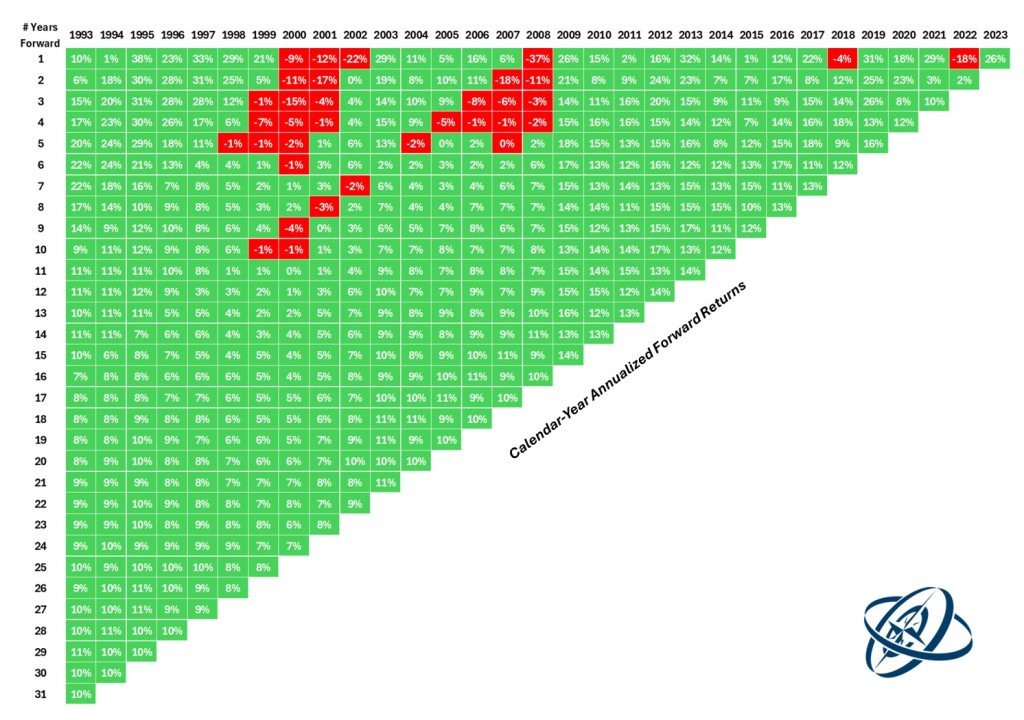
One of the most insightful graphs for anyone interested in investing shows the annualized returns of the S&P 500 from various starting points. It acts as a time map, revealing year-by-year what would have happened to your capital if you had invested at a given point and left your money to grow for 1, 3, 5, 10, or 20 years. It’s a vivid snapshot of just how crucial time is in the world of investing.

Let’s take an example: If you had started investing in 2005, you would have achieved an average annual return of 3% after six years and 8% after ten years. These numbers tell different stories depending on your perspective: a weak decade or one defined by resilience. What stands out, however, is the dominance of green on the graph. In the vast majority of cases, the longer you invest, the better the returns. This isn’t just a motivational slogan—it’s the proven strength of the stock market over time.

When Does “Long-Term” Really Become Long-Term?

In financial theory, 10 years are often considered “long-term”. But in real life, 10 years can feel like a lifetime. It’s the time that separates a thirty-year-old from a forty-year-old, a recent graduate from a seasoned professional, or someone without children from a parent. In a decade, everything can change. Yet, in finance, 10 years might not be enough.

The stock market can be brutal in the short term. There have been periods over the past century where even the world’s most renowned index, the S&P 500, delivered negative or almost zero returns. Anyone who invested everything at the wrong time and endured two consecutive crashes would have seen their investments suffer greatly. However, looking beyond 15 years, there has never been a period in modern history where the returns were negative.

Over 20 years, the annual return of the S&P 500 has always ranged from 6% to 10%. In other words: the risk of loss diminishes with time, and so does the anxiety over entering the market at the “wrong” moment.

Time Matters Much More Than Timing

Many investors, especially at the start, obsess over “when to enter.” They wait for a market crash, fear a peak, and analyze charts as if they hold prophetic power. But when the time horizon is long, the exact moment you enter matters far less than how long you remain invested.

For instance, the worst annual return in one year was -37%, and the best was +38%. Over five years, the range tightens to -2% versus +18% annually. After ten years, it spans from -1% to +17%. After twenty years, all the returns are positive.

This tells us that the most important factor isn’t the day you invest, but how long you stay invested.

You Don’t Need Exorbitant Returns

An often-overlooked aspect of investing is that not everyone needs to chase high returns. The goal isn’t to outperform the market but to achieve your financial goals while minimizing stress and effort.

For example, if you have €100,000 and need it for a trip or another short-term goal, investing in a money market ETF offering around 3.5% per year is perfectly sufficient. Secure and stable.

On the other hand, if you have €1,000,000 and are aiming for a steady income, a modest 4% return would generate €40,000 annually—enough to cover a comfortable standard of living without major surprises.

But if you’re young, with low initial capital, high saving potential, and a long time horizon (20-30 years), accepting volatility and investing primarily in stocks makes sense. It’s in these years that returns accumulate, and time becomes your best ally.

The Secret? Planning

Good financial planning isn’t just about plugging a 7% return into a compound interest calculator and seeing how much you’ll have in 30 years. It’s about asking yourself:

  • What returns do I really need?
  • When will I need the money?
  • How much volatility can I tolerate without losing sleep?
  • Can I afford to “forget” about this investment for 15 years?

The answers to these questions will guide your decisions: asset allocation, time horizon, and the right instruments for your goals.


Conclusion

The stock market remains the cornerstone for long-term investors. However, the definition of “long-term” is subjective and depends on personal circumstances. For some, it’s 10 years, for others 30. What matters most is understanding where you are in your life’s journey and adjusting your strategy accordingly.

Rather than striving for the perfect market entry, focus on finding the right balance between time, goals, and peace of mind.

Living off Your Investments: What You Really Need to Know

In recent years, the concept of financial independence has gained significant traction. More people are looking to retire early, relying solely on their investments to cover their living expenses. But while the idea of living off your portfolio may sound appealing, it’s crucial to dive deeper into what it truly means, especially considering the challenges involved.

What Does It Take to Live Off Your Investments?

To live off your investments, you essentially need a portfolio that generates enough passive income to cover your living costs. The traditional rule many refer to is the “4% Rule,” which suggests that if you accumulate enough wealth to withdraw 4% annually from your investment portfolio, you can maintain your lifestyle indefinitely without depleting your capital.

For instance, if you need $40,000 per year to cover your living expenses, your portfolio should amount to at least $1 million ($40,000 ÷ 0.04). This approach works under the assumption that your investments will grow at a reasonable rate, typically around 7% per year, which has been the average return of the S&P 500 over the long term.

But here’s the catch: while the 4% rule is a helpful guideline, it doesn’t account for critical variables such as inflation, market volatility, or unexpected life events.

The Key Factor: Portfolio Growth

One of the biggest mistakes people make when planning to live off their investments is not considering how their portfolio needs to continue growing. Without growth, the effects of inflation will erode your purchasing power, and eventually, your portfolio will not be able to cover the same lifestyle it once did.

Let’s say you retire and rely on a 4% annual withdrawal. In the early years, this can work well. However, over time, inflation will increase the cost of living, and you may find yourself needing to withdraw more than the original 4% to maintain the same standard of living. That’s why it’s crucial that your portfolio grows at least at the rate of inflation—or even better, generates extra returns that can be reinvested to maintain and grow your wealth.

In short, your portfolio must continue to generate returns and ideally be reinvested, so that it doesn’t just maintain the purchasing power but also keeps growing. Simply withdrawing the entire gain each year may not be enough. You need to ensure your portfolio outpaces inflation, or else your money will lose value over time.

The Reality: Periods of Below-Average Returns

Another important consideration is market performance. Over time, the market doesn’t always deliver high returns. There will be periods of stagnation or even downturns. In these years, your portfolio might not generate the same returns as expected, or might even suffer losses.

During such periods, it’s crucial that you don’t tap into your principal. Otherwise, you risk diminishing your portfolio just when it’s most vulnerable. Ideally, you should be able to cover living expenses from your portfolio’s income without dipping into the capital, especially during lean years. This means living off dividends and interest rather than capital gains, which will allow your investments to continue working for you even in tough times.

The Importance of Managing Big Expenses

While saving on small daily expenses can be helpful, it’s not where the real difference lies in living off investments. You might save a few bucks by cutting out that morning coffee or choosing a cheaper yogurt, but these small savings won’t have a significant impact on your financial independence.

Instead, focus on managing the big expenses. This includes housing costs, insurance premiums, healthcare, and other major financial commitments. For example, having the right insurance coverage can protect you from unexpected large costs that could derail your financial plans. Similarly, having an emergency fund ensures that you can cover sudden expenses without needing to liquidate parts of your portfolio, especially during market downturns.

The Balance Between Freedom and Lifestyle

It’s crucial to understand that achieving financial independence doesn’t mean living a life of extreme frugality or deprivation. A comfortable retirement is about having the freedom to enjoy life, not about cutting back every possible expense. You shouldn’t aim for a “bare-bones” lifestyle just to live off your investments. It’s important to find a balance that allows you to live comfortably while also securing your future.

The goal of financial independence should be to give you the freedom to spend your time as you wish, without worrying about money. This means your portfolio should allow you to maintain a standard of living that supports your happiness and well-being, not force you into a lifestyle of constant sacrifice.

Conclusion: A Strategic Approach to Living Off Your Investments

Achieving financial independence through investments is an attainable goal, but it requires strategic planning, discipline, and flexibility. You need to be realistic about the amount of wealth required to maintain your desired lifestyle, and you must ensure that your portfolio is well-managed to weather both market highs and lows.

The 4% rule can be a good starting point, but it’s essential to remember that your portfolio needs to grow consistently to outpace inflation and ensure that you don’t run out of funds in the future. Additionally, managing large expenses effectively and maintaining a balance between enjoying life and saving for the future is key to making your investment journey sustainable.

By approaching the idea of living off your investments with a clear, long-term strategy, you can achieve financial independence and secure the freedom to live life on your terms.

3 Truths About Investing You Should Remember (Especially on the Worst Days)

We live in an era where access to financial markets has never been easier or more democratic. And yet, fear still dominates the decisions of many investors—or worse, those who avoid investing altogether.

You don’t need complex formulas or crystal-ball predictions to navigate this world. Sometimes, just three simple data points can radically shift your perspective. Not only do they show what the market has done—they also reflect how human behavior reacts to it.

Here are three essential truths every investor should write down and revisit—especially when the skies look darkest.

1. The Market Is Positive More Often Than You Think

Over the past 25 years, the U.S. stock market (S&P 500) ended the year in the green 17 out of 25 times. That’s 68% of the time.

Put another way: nearly 7 out of every 10 years delivered a positive return.

So why does it always feel like a crash is looming?

Because the human mind is wired to remember pain more vividly than peace. Crashes, shocks, and losses make noise. Gains? They happen quietly.

This leads to a distorted perception of reality.

Investing is counterintuitive: you often need the courage to stay the course exactly when every instinct tells you to run.

2. Even in Winning Years, There Were Sharp Drops

Here’s the more surprising truth: even in most of those positive years, the market experienced temporary declines of 5–10%, and in some cases even 20% or more.

Yet those dips did not stop the market from finishing the year in profit.

This is a misunderstood concept: volatility isn’t the price of admission—it’s the nature of the ride.

Some see a temporary -10% drop and think, “I need to sell before it gets worse.” Others recognize it as a normal part of the journey—and maybe even an opportunity to invest more.

3. Long-Term Investors Have Been Rewarded—Despite Everything

From 1999 to 2024, the world went through:

  • The dot-com bubble,
  • The 2008 global financial crisis,
  • The 2020 pandemic,
  • Not to mention Brexit, wars, European debt crises, and more.

Yet, an investor who put $100,000 into the S&P 500 at the start of that period would now have $666,300with dividends reinvested.

That’s a total return of +566%, or an annualized return of 7.85%.

A performance that no savings account or government bond could even come close to matching.

But This Is Not a Magic Formula to Get Rich

These numbers are not guarantees.

They do not mean that:

  • The next 25 years will necessarily look the same;
  • Everyone should put all their savings into the S&P 500;
  • It’s easy to stay invested during the worst moments.

The truth is, investing isn’t just math. It’s psychology.

Knowing the market has rewarded patience is helpful—but staying the course when everything feels like it’s falling apart is what really sets successful investors apart.

Final Thought: Three Stats, One Clear Message

The data tells a simple, powerful story: the market rewards patience, consistency, and knowledge.

Investing is not gambling. It’s not about “timing the market.” It’s about embracing time, volatility, and even discomfort.

Those who can do this often look back and realize that the crises which once felt terrifying were merely part of the journey toward a better financial future.

What Warren Buffett’s Most Iconic Quotes Teach Us: 7 Timeless Investment Strategies

Warren Buffett, one of the wisest and most successful investors in history, has consistently shared his strategies and philosophy for building wealth. His quotes are timeless pearls of wisdom that not only help understand how to approach investments but also offer life lessons applicable to many aspects of our lives. In this article, I have selected seven of his most famous quotes and analyzed them, relating them to current economic developments and the opportunities we can seize today.

1. “The stock market is simple: buy shares of a great company for less than their intrinsic value. The company should be run by competent and honest managers. Once you’ve done that, hold the shares forever.”

According to Buffett, the key to investment success is purchasing high-quality companies at a reasonable price and holding on to the shares for the long term. In a market that tends to favor short-term investing and frantic trading, Buffett encourages us to adopt a long-term investment strategy focused on intrinsic value and competent management. Today, with increasing access to financial analysis and corporate performance data, the question is: how can we identify a good deal in a rapidly changing market? The answer lies in seeking solid management and having the patience to allow the company to grow over time.

In this article, I also discussed alternative strategies for evaluating companies to invest in.

2. “Investing must be rational: if you don’t understand it, don’t do it.”

Buffett reminds us that knowledge is power: without fully understanding an investment, we should never take the plunge. The most common mistake is getting swept up in the latest trend, as is often the case with popular stocks or cryptocurrencies. The importance of only investing in what you truly understand is more crucial than ever today, when markets are filled with complex assets that are difficult to analyze without a solid background. Buffett’s advice is to avoid blind greed and make decisions based on a strong understanding of the businesses and assets we invest in.

3. “It’s better to be approximately right than precisely wrong.”

It’s okay to be informed, but there’s no need to have all the perfect and precise information (which, by the way, is very hard to come by). This quote teaches us that action is often more important than perfection. In the world of investing, the error of striving for perfection can be more harmful than a rough estimate. If we wait too long to obtain “certainty” on every single detail, we might miss the boat. Acting with a reasonable approach and accepting a margin of error is far more effective than endlessly searching for precision. Patience is key to avoiding decision paralysis and making choices that, while not perfect, are sufficiently right.

4. “The first rule is not to lose. The second rule is not to forget the first rule.”

This quote underscores the importance of protecting capital. Buffett highlights that diversification is one of the best techniques to reduce risk. During events like the 2008 financial crisis, when many investors suffered devastating losses, Buffett demonstrated that prudence and risk management are essential to navigating the turbulent waters of the market. While diversification might reduce potential returns, it helps protect against unforeseen events—the so-called “black swans.” Without diversification, we risk seeing our capital wiped out due to a single mistake.

In this article, I also touched on a particular type of diversification, geographical diversification.

5. “Be greedy when others are fearful, and fearful when others are greedy.”

Buffett’s words capture one of the most powerful concepts of contrarian investing. Markets are often driven by emotions: fear during crises and greed during booms. Buffett encourages us to exploit these collective emotions: buy when others are selling out of fear, and sell when everyone is swept up in euphoria. During the 2008 financial crisis, Buffett made bold bets on the market’s recovery, profiting immensely when others were paralyzed by fear. The lesson here is that the contrarian investor often finds incredible opportunities when the market is most fearful.

In this article, I also discussed this topic.

6. “In business, the best thing to do is the simplest thing, but doing it is always very difficult.”

Buffett warns us that while simplicity is key to business success, it’s often difficult to execute. Too often, investors and entrepreneurs are tempted by complex strategies or projects that seem promising but end up in confusion. Investing in solid companies, buying at reasonable prices, and maintaining a diversified portfolio are all actions that are simple to understand but require discipline to implement. The real difficulty lies in staying true to these rules without being distracted by the complexity and noise of the market.

Do you remember what the Super Bowl taught us?

7. “It takes just as little time to see the positive side of life as it does to see the negative side.”

Buffett reminds us that a positive attitude is a powerful asset, especially in challenging times. During the 2008 crisis, Buffett chose to bet on the recovery. When asked why he was so optimistic, he simply replied that there was no alternative: either he would win (and make a lot of money), or capitalism would collapse and money would lose its value. Choosing to remain optimistic and invest in the recovery wasn’t just the right move—it was the only sensible one. Having a positive mindset allows us to spot opportunities even in the toughest times. It helps us react proactively and look toward the future with hope, rather than being overwhelmed by fear and uncertainty.

In this article, I talked about the importance of staying rational, and thus optimistic, even in the worst of times.

Conclusion

Warren Buffett’s quotes serve as an indispensable guide for anyone who wants to understand the fundamental principles of investing and financial success. His philosophy is rooted in rationality, patience, optimism, and diversification. Investing in solid companies at reasonable prices, holding a portfolio for the long term, and knowing how to seize opportunities when others are fearful are lessons that remain valid in today’s financial landscape.

If you resonate with this philosophy, you can start implementing these strategies and, as Buffett says, “being approximately right” is far better than being precisely wrong.

An Extra 1% Every Year: How a Small Increase in Investments Can Lead to Incredible Results

Imagine you had the opportunity to increase just 1% the percentage of your salary you save or invest each year. It might seem like a trivial change, right? Yet, by applying this simple adjustment over several years, the results could be astonishing. Thanks to compound interest, even the smallest percentage increase can make a huge difference in the long run.

A Concrete Example: The Power of 1% Annually

Let’s assume you decide to save 10% of your salary every year and invest this amount in a portfolio that offers a 5% annual return. If you maintain this consistent savings rate for 30 years, the amount you accumulate will be impressive.

  • Year 1: Save $1,000.
  • Subsequent years: Each year, you earn a 5% return on your investments.

At the end of the 30 years, you’ll have accumulated approximately $100,000 due to this consistent saving. But now, let’s imagine what would happen if you decided to increase the percentage of your savings by a modest 1% each year. Starting from the initial 10%, in the second year, you’d save 11%, in the third year 12%, and so on.

The Impact of an Additional 1% Each Year

Let’s consider that your savings rate starts at 10%, and you increase it by 1% every year (so, in the second year, you save 11%, in the third year 12%, and so on). If you apply this incremental increase each year for 30 years, the final amount won’t just be higher; it will also experience exponential growth due to compound interest.

  • Year 1: You save $1,000.
  • Year 2: You save $1,100 (1,000 + 10% of the previous year).
  • Year 3: You save $1,210 (11% of the previous year).

Continuing in this manner, over time, your capital grows significantly. Thanks to the annual increase of 1%, by the end of 30 years, you could have accumulated not just $100,000, but around $150,000 or more, depending on market conditions. This happens because you’re not only increasing the amount you save every year, but the interest on your savings is multiplying as the total sum you’re working with grows.

The Final Result: The Power of Consistency

What does this all mean? If you start saving and investing just 1% more each year, without even noticing it, your savings and investments will grow at a much faster rate. The key to all of this is compound interest: it’s not just about the money you save, but how that money grows over time thanks to the interest that compounds on itself. At first, the effect may seem slow, but as time passes, it becomes increasingly significant. A 1% annual increase may seem minimal, but the cumulative effect over 10, 20, or 30 years is incredible.

The Dynamics of Compound Interest

To better understand, you need to realize that compound interest is a process that sustains itself. Each year, the amount you’ve invested grows not just because of the money you’ve put aside, but also because of the interest added to your existing capital. In the beginning, the effect may be slow, but over time, it becomes more and more powerful. A 1% annual increase may seem negligible, but the cumulative effect on your savings over 10, 20, or 30 years is remarkable.

In conclusion, even a small increase like 1% can have an enormous impact over time. The key lies in consistency and patience: with compound interest, every small saving effort adds up and grows exponentially, leading to extraordinary results that you might not have imagined when you first started. Don’t underestimate the power of a small annual increase — over time, it will make a massive difference for your financial future.

Determining Your Risk Tolerance: The Key to Successful Investing

In the world of investing, the concept of risk is ever-present. We hear about it in terms of performance, management, measurement, and strategies. Often, when thinking about how to manage investments, investors tend to focus too much on mathematical and quantitative metrics such as standard deviation, value-at-risk (VaR), or the well-known Sharpe ratio. While these tools are useful for financial analysts, the true heart of risk management lies in a much more personal and subjective concept: your risk tolerance.

Risk isn’t just a mathematical calculation; it’s also about the ability and willingness to take on risk. Every investor has a different perception of risk, which reflects not only the types of assets they invest in but also their emotional and psychological responses to market movements. Understanding your risk tolerance is critical to developing an investment strategy that meets your long-term goals without keeping you awake at night.

The Nature of Risk: More Than a Mathematical Issue

Financial risk can be defined as the uncertainty about the future returns of an investment. While tools like Monte Carlo simulations or standard deviation analysis may provide statistical insights into the likelihood of gains or losses, they can’t predict the unpredictable. The greatest risk is always the unknown—the uncertainty every investor must deal with. No matter how sophisticated the analytical tools are, there’s always an element of risk that remains out of sight.

There are three categories of risk in investment theory: the “known-knowns”, the “known-unknowns”, and the “unknown-unknowns”. These concepts help us understand that, despite all the technology and economic forecasting, the future is inherently unpredictable. Investors, therefore, can never be completely prepared for every eventuality. The only aspect we can exercise direct control over is our approach to risk management.

Risk Tolerance: Capacity vs. Willingness

When talking about risk tolerance, it’s important to distinguish between your capacity to take on risk and your willingness to do so. Capacity is based on objective factors such as age, net worth, income, future earnings potential, and your investment horizon. A young professional, for example, has a greater capacity to take on risk since they have a longer investment horizon and can afford to recover from any potential losses.

However, your willingness to take on risk is a different matter. Even if you have the capacity to bear higher risk, you may not feel comfortable doing so. Your emotional tolerance for risk may dictate your investment choices. Some investors may prefer a more conservative strategy to help them sleep better at night.

It’s important to find a balance between your ability to take on risk and your comfort level. While you may think that holding cash in a savings account is risk-free, inflation can erode your purchasing power, which could jeopardize your ability to meet long-term financial goals.

The Types of Risks You Should Consider

When you invest, you face various types of risk, which manifest in different ways. The key risks to be aware of are:

  1. Permanent loss of capital: The possibility of losing your investment irreversibly. This is one of the most severe risks, as there is no way to recover a permanent loss.
  2. Downside risk: The risk of losing more than you are emotionally or financially prepared to handle.
  3. Upside risk: The fear of missing out on potential gains. In other words, the risk of not capturing growth opportunities.
  4. Loss of purchasing power (inflation): Inflation diminishes the real value of money over time. Even if the nominal value of your portfolio increases, inflation can erode your purchasing power, undermining your long-term goals.
  5. Failing to reach your financial goals: This is the most impactful risk because failing to achieve your goals (such as retirement or funding education) has a direct effect on your quality of life. This type of risk is far more damaging than the volatility of returns.

Risk Tolerance: How to Evaluate It

Determining your risk tolerance involves considering two primary factors: your ability and your willingness to take on risk. Your ability is measured through objective indicators such as income, net worth, age, and investment horizon. Your willingness is a more psychological aspect and depends on how comfortable you are with market volatility.

If you’re young and have a long-term investment horizon, your capacity to take on risk will be higher. Also, you can assume that your income will rise over time, so you’ll have the ability to replenish any losses through increased savings. However, if you’re nearing retirement, you will need to adjust your portfolio to reduce risk and protect your capital.

Strategies for Managing and Reducing Risk

Since risk can never be fully eliminated, it’s crucial to have a strategy to manage it effectively. Here are some key strategies that can help reduce risk over time:

  1. Have a solid investment plan: This includes setting clear goals and devising a strategy for how you will react to different market scenarios. Writing it down allows you to review it when tempted to make irrational short-term decisions.
  2. Diversification: Spread your investments across different asset classes, geographies, and sectors. While diversification won’t guarantee huge returns, it will help you avoid catastrophic losses.
  3. Asset allocation: This is the mix of stocks, bonds, real estate, cash, and alternative investments in your portfolio. Your asset allocation has a much bigger impact on your returns than any individual stock or fund you choose to invest in.
  4. Rebalancing: Regularly rebalancing your portfolio forces you to sell winners and buy losers to maintain your target asset allocation. Doing this periodically ensures that you remain aligned with your stated risk parameters.
  5. Dollar-cost averaging (DCA): DCA is a strategy that helps you invest periodically over time to reduce the risk associated with market timing. It allows you to spread your purchases over a longer timeframe, making market volatility work in your favor.
  6. Aligning investments with your time horizon: Each financial goal comes with its own time horizon. Short-term goals (e.g., emergency savings) should have lower-risk investments, while long-term goals (e.g., retirement) can afford higher risk in exchange for potential growth.
  7. Control your emotions: Putting your finances on auto-pilot and avoiding the temptation to time the market is essential. Having a well-thought-out plan will also help you stay away from the vicious cycle of fear and greed.
  8. Keep it simple: Simple strategies are often the most effective. Avoid complex products or strategies that you don’t fully understand. This alone will help you avoid unnecessary risk and likely lower your costs.
  9. Save more: The more you save, the lower your risk of not achieving your goals. Increasing your savings reduces your exposure to potential losses and helps you stay on track.

Conclusion

Investing is a marathon, not a sprint. Acknowledging that we cannot predict the future and that there will always be unknown risks is an essential step toward managing your emotions and minimizing unnecessary risk. Risk tolerance is the first step in crafting a successful investment strategy that works for you—one that aligns with your goals, limits unnecessary anxiety, and increases the likelihood of success in an unpredictable world.

Three Years Since the Russian Invasion of Ukraine: A Tragedy That Taught Us Valuable Lessons

Today, February 24, 2025, marks exactly three years since the Russian invasion of Ukraine. This event has profoundly impacted not only the history of our time but also global geopolitics and the way we live. The human suffering, destruction, and uncertainty that followed this conflict are difficult to measure, but the world did not stop. Global economies, investors, and financial markets have continued to evolve, adapting to a situation that initially seemed impossible to predict.

Today, we want to reflect on what these three years have taught us. Not only about political and military dynamics but also about how such significant geopolitical events can influence financial markets, and, most importantly, how we can draw lessons from history to face future uncertainties.

The Stock Market’s Reaction to Geopolitical Shocks

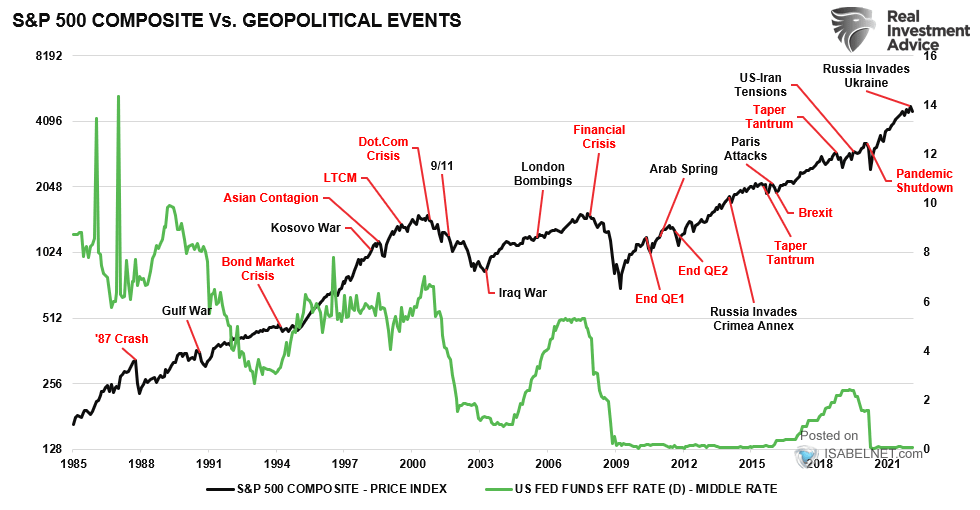
The situation in Ukraine made me reflect on how geopolitical events influence financial markets. One of the most useful tools for understanding these dynamics is historical analysis, particularly the LPL Research chart, which shows the S&P 500’s reaction during major geopolitical shock events over the last decades.

What stands out from this analysis is clear: wars and geopolitical shocks can create turmoil in financial markets, but historically, they have never led to the end of the stock market. Sure, there are moments of intense volatility, but the market has always had the ability to recover. Crises, while painful and destabilizing, are part of the cyclical nature of markets.

The interesting fact, however, is that the emotional reaction caused by these events remains similar over time. Fear, uncertainty, and instability drive mass sell-offs, but that does not mean the market crashes permanently. In fact, looking at past events, we can see that the market, despite initial turbulence, has always rebounded. Therefore, although no one can predict with certainty what will happen in the future, history teaches us to reason rationally rather than follow the emotional impulse of the moment.

The Lesson of Human Progress: Investing with Rationality

Geopolitical crises show us the resilience of society and human economies. History teaches us that, despite the initial chaos, opportunities for growth and progress never stop. Over the long term, the market has always reacted to crises with innovation, adaptation, and, above all, a desire to overcome adversity.

Take past wars as an example: World War II, the Vietnam War, or even the 2008 financial crisis. In all of these cases, the market reactions were initially severe, but eventually, the economy recovered and continued to grow. It is essential to remember that humanity has an extraordinary capacity for renewal, and this is something investors need to keep in mind.

History teaches us that the odds are in our favor when we bet on creativity, technological progress, and resilience. The war in Ukraine, sadly, is an example of how devastating geopolitical events can be, but also of how, in the long term, the adaptability of markets and global economies can transform these challenges into opportunities for growth.

Geographic Diversification: Protection Against Shocks

Another crucial lesson that emerges from situations like the Russian invasion of Ukraine is the importance of geographic diversification in investments. When the Russian stock market collapsed by 50% on February 24, 2022, the negative effects were felt immediately. However, the losses were not universal, and diversification played a key role in mitigating the impact.

To provide a concrete example, Russia accounted for 0.38% of the MSCI All World Index and 2.99% of the MSCI Emerging Markets Index. This means that even if the Russian economy had completely collapsed, the total loss for global investors would have been limited to 0.38% in one case and 2.99% in the other. This example underscores the importance of having a well-diversified portfolio geographically, to limit the impact of isolated events that may trigger strong turmoil in a specific region.

Geographic diversification is not only a prudent strategy; it is a real form of protection against uncertainty. When a local market experiences severe shocks, other sectors or geographic areas may still perform positively, compensating for the losses. History teaches us that events like wars, political crises, or economic shocks have a limited impact if the portfolio is well-balanced across different regions and sectors.

Conclusion

Looking back at these three years, we can see how the stock market, despite the initial difficulties caused by the Russian invasion of Ukraine, is slowly recovering. Resilience and the ability to adapt are intrinsic characteristics of markets, and our role as investors is to navigate uncertainty with rationality, keeping in mind the lessons of the past. Geographic diversification is a fundamental strategy for protecting your portfolio and handling periods of turbulence.

The future is never certain, but with proper planning, we can be better prepared to face it with greater confidence, knowing that hardships, no matter how significant, are never meant to last forever.

The Market is Expensive, Should You Wait to Invest?

The world of investing is a jungle of opportunities and uncertainties. One of the most common questions that investors are asking right now revolves around the high levels of the financial markets: is it wise to invest now, when valuations are so high? Should we wait for a correction or even a crash before entering the market? Or is it better to start immediately and begin building a portfolio that aligns with your goals, despite the challenges?

Markets Above the Average: How to Assess the Current Situation?

The financial markets are currently at a point that raises many concerns. Valuation metrics such as the P/E (Price-to-Earnings) and CAPE (Cyclically Adjusted Price-to-Earnings) are well above historical averages, suggesting that stocks are expensive relative to their earnings. In fact, similar values have only been seen in rare instances such as 2000 and 2020. However, it is essential to understand that these numbers alone do not tell the whole story.

While prices are high, the current economic context is different from other periods of market bubbles. Companies are generating solid profits, with strong fundamentals supporting a portion of these elevated valuations. Even so, the question remains: how do we navigate this situation?

Don’t Wait for the Correction: The Best Move Is to Invest Now

One of the most important lessons every investor should learn is that the markets wait for no one. While the temptation to “wait for the correction” might seem reasonable, the reality is that markets can remain irrational for prolonged periods. An attitude of waiting, hoping to buy at lower prices, only risks leading to missed opportunities.

Consider the stock markets of the past few decades: if an investor had stayed out of the market waiting for corrections, they would have missed some of the best historical performances. Moreover, markets don’t always drop as expected, and when a crash finally does come, we may be too scared or indecisive to take the right action.

Cash: A Resource to Use Wisely

Cash plays a crucial role in a well-balanced portfolio, but not in the way many might think. Many investors use cash as a parking spot, waiting for the right moment to enter the market. However, this approach is often counterproductive. Cash should be used as an emergency reserve, a buffer against volatility, and protection in times of economic uncertainty.

Of course, it can be helpful to keep some liquidity for short-term goals that require stability and low volatility. However, it should not become a way to delay exposure to the risks of the markets. In the long term, inflation and the growth of the stock markets tend to erode the purchasing power of cash.

The Risk of Postponing: Losing Opportunities

Every time you delay entering the market, you are simply postponing the risk. Over the long term, markets tend to grow, and any waiting for a “better moment” ultimately reduces your potential for returns. Investment strategies like market timing – trying to predict the right moment to buy or sell – are generally ineffective. While sometimes timing can yield good results, over the long term, this practice often leads to inferior outcomes compared to a consistent and disciplined strategy.

A better approach is to start investing now, with a portfolio that aligns with your financial goals, your risk tolerance, and your time horizon. There’s no need to wait for the “market crash” or chase perfect timing; markets tend to follow growth trends, and the time spent in the market is one of the main factors in wealth creation.

Planning: The Key to Long-Term Success

Investing is not a mysterious art or a game of chance. The real key to investment success is planning and discipline. Building a well-diversified portfolio that properly balances risk and returns is the first step. Having clear financial goals and a defined time horizon will help you withstand short-term fluctuations and make more rational decisions.

Moreover, avoid the mistake of focusing only on immediate returns. True value is created over the long term, and those who invest with a long-term perspective and a well-thought-out strategy will likely be rewarded.

Conclusion: Invest with Awareness, Not Fear

Investing in an expensive market does not necessarily mean making a risky bet. While valuations may seem high, the long-term growth prospects remain positive. The most important lesson is to never delay. Waiting for the “perfect moment” could make you miss out on great opportunities.

Investing with awareness means recognizing that we can’t predict the future, but we can make informed decisions that reflect our goals, our situation, and our risk tolerance. If you invest with a well-defined plan and a long-term strategy, you will be able to navigate any market correction with confidence, without missing the opportunity to build wealth over time.

Investing is a journey, not a destination. And like any journey, the best time to start is always now.