Gold Investment in 2025: Why the Safe Haven is Back in the Spotlight

In an era defined by economic uncertainty, persistent inflation, and rising geopolitical tensions, gold is once again asserting itself as a strategic asset for both individual and institutional investors. The year 2025 marks a pivotal moment for the yellow metal—not just for its price performance, but for its renewed role as a hedge against market volatility and a tool for portfolio diversification.

Why Gold is Gaining Momentum in 2025

Global central banks are facing a delicate balancing act. While inflation remains above targets, slowing growth and fragile markets demand monetary easing. In this environment, investors are seeking stable, uncorrelated assets that preserve purchasing power.

As a result, demand for gold is on the rise. Central banks—particularly in Asia and Latin America—are reducing their reliance on the US dollar by increasing gold reserves. Simultaneously, retail investors are returning to gold as a hedge against fiat currency depreciation and market shocks. These forces have contributed to record-high prices in the first quarter of 2025.

How to Invest in Gold: The Main Options

1. Physical Gold: Tangible Value with Practical Limits

Buying physical gold (bars or coins) is the most traditional method of investment. It offers direct ownership and protection from currency devaluation and systemic risks. However, it comes with downsides: storage, insurance, no passive income, and potentially limited liquidity.

For long-term preservation, mid-sized bars (e.g., 50g or 100g) strike a good balance between cost efficiency and ease of resale.

2. Gold ETFs: Efficient Market Exposure

Gold ETFs (Exchange Traded Funds) offer an accessible, low-cost way to gain exposure to gold prices. They trade like stocks and require no storage or handling of the physical metal. However, investors should be aware that not all ETFs are backed by actual gold—some are derivatives-based.

In 2025, the best strategy is to focus on physically backed gold ETFs stored in audited vaults. Top options include SPDR Gold Shares (GLD) and Invesco Physical Gold (SGLD).

3. Gold Mining Stocks and Funds: Higher Risk, Higher Reward

Investing in gold mining companies provides an indirect exposure to the gold price, often with leverage on upward movements. While potentially more profitable, this strategy also involves higher volatility and company-specific risk.

Diversification is essential—consider gold mining ETFs like VanEck Gold Miners (GDX) or VanEck Junior Gold Miners (GDXJ) to spread risk across the sector.

Common Mistakes to Avoid When Investing in Gold

  • Chasing prices at peak levels: Gold is a long-term hedge, not a short-term speculation.
  • Ignoring currency effects: For non-USD investors, exchange rate volatility can impact returns.
  • Investing without a clear strategy: Without defined objectives, gold may underperform or act counterproductively.

How Much Gold Should You Hold in Your Portfolio?

The optimal allocation to gold depends on the investor’s profile and existing asset mix. Most modern portfolio theories suggest a gold allocation between 5% and 15%, depending on:

  • Risk tolerance
  • Exposure to cyclical or fiat-based assets
  • Views on inflation and macroeconomic risk

Some investors use a tactical approach: increasing gold holdings in times of market stress and reducing exposure during periods of stability.

The Strategic Role of Gold in Modern Portfolios

Gold should not be seen as a speculative bet, but as a strategic insurance policy. In a world where “normal” is increasingly unstable, gold offers resilience. When properly integrated into an investment strategy, gold can:

  • Preserve capital during inflationary cycles
  • Reduce portfolio volatility
  • Hedge against systemic shocks

In 2025, investing in gold means taking control of your financial security—beyond trends, beyond hype, and with a long-term view.

Long-Term Investing: What Does “Long-Term” Really Mean?

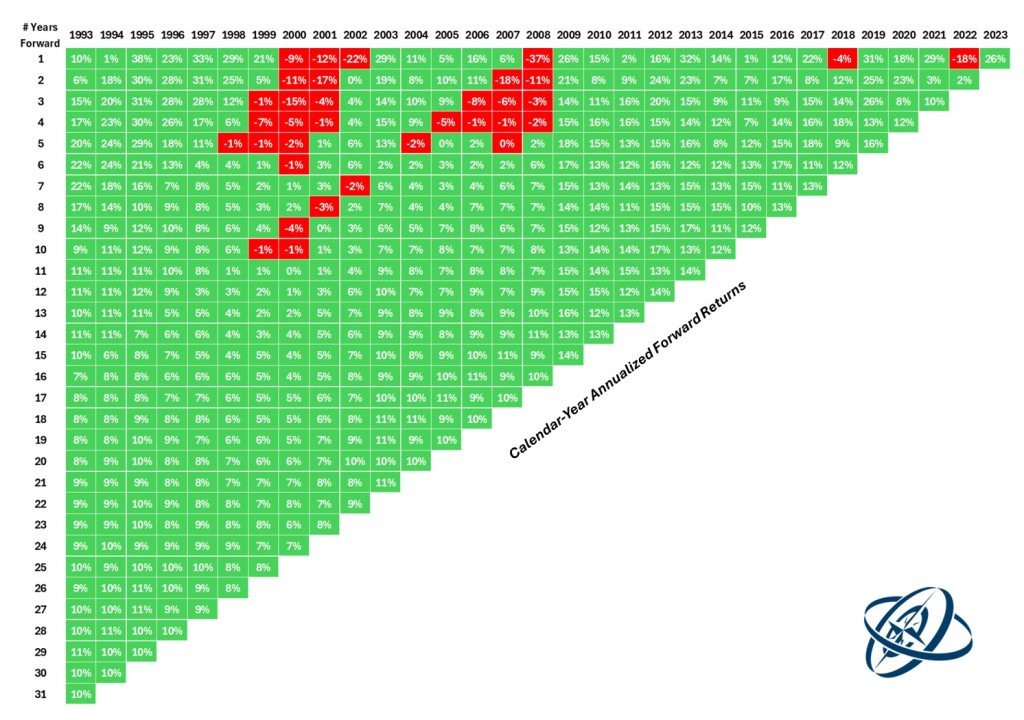
One of the most insightful graphs for anyone interested in investing shows the annualized returns of the S&P 500 from various starting points. It acts as a time map, revealing year-by-year what would have happened to your capital if you had invested at a given point and left your money to grow for 1, 3, 5, 10, or 20 years. It’s a vivid snapshot of just how crucial time is in the world of investing.

Let’s take an example: If you had started investing in 2005, you would have achieved an average annual return of 3% after six years and 8% after ten years. These numbers tell different stories depending on your perspective: a weak decade or one defined by resilience. What stands out, however, is the dominance of green on the graph. In the vast majority of cases, the longer you invest, the better the returns. This isn’t just a motivational slogan—it’s the proven strength of the stock market over time.

When Does “Long-Term” Really Become Long-Term?

In financial theory, 10 years are often considered “long-term”. But in real life, 10 years can feel like a lifetime. It’s the time that separates a thirty-year-old from a forty-year-old, a recent graduate from a seasoned professional, or someone without children from a parent. In a decade, everything can change. Yet, in finance, 10 years might not be enough.

The stock market can be brutal in the short term. There have been periods over the past century where even the world’s most renowned index, the S&P 500, delivered negative or almost zero returns. Anyone who invested everything at the wrong time and endured two consecutive crashes would have seen their investments suffer greatly. However, looking beyond 15 years, there has never been a period in modern history where the returns were negative.

Over 20 years, the annual return of the S&P 500 has always ranged from 6% to 10%. In other words: the risk of loss diminishes with time, and so does the anxiety over entering the market at the “wrong” moment.

Time Matters Much More Than Timing

Many investors, especially at the start, obsess over “when to enter.” They wait for a market crash, fear a peak, and analyze charts as if they hold prophetic power. But when the time horizon is long, the exact moment you enter matters far less than how long you remain invested.

For instance, the worst annual return in one year was -37%, and the best was +38%. Over five years, the range tightens to -2% versus +18% annually. After ten years, it spans from -1% to +17%. After twenty years, all the returns are positive.

This tells us that the most important factor isn’t the day you invest, but how long you stay invested.

You Don’t Need Exorbitant Returns

An often-overlooked aspect of investing is that not everyone needs to chase high returns. The goal isn’t to outperform the market but to achieve your financial goals while minimizing stress and effort.

For example, if you have €100,000 and need it for a trip or another short-term goal, investing in a money market ETF offering around 3.5% per year is perfectly sufficient. Secure and stable.

On the other hand, if you have €1,000,000 and are aiming for a steady income, a modest 4% return would generate €40,000 annually—enough to cover a comfortable standard of living without major surprises.

But if you’re young, with low initial capital, high saving potential, and a long time horizon (20-30 years), accepting volatility and investing primarily in stocks makes sense. It’s in these years that returns accumulate, and time becomes your best ally.

The Secret? Planning

Good financial planning isn’t just about plugging a 7% return into a compound interest calculator and seeing how much you’ll have in 30 years. It’s about asking yourself:

  • What returns do I really need?
  • When will I need the money?
  • How much volatility can I tolerate without losing sleep?
  • Can I afford to “forget” about this investment for 15 years?

The answers to these questions will guide your decisions: asset allocation, time horizon, and the right instruments for your goals.


Conclusion

The stock market remains the cornerstone for long-term investors. However, the definition of “long-term” is subjective and depends on personal circumstances. For some, it’s 10 years, for others 30. What matters most is understanding where you are in your life’s journey and adjusting your strategy accordingly.

Rather than striving for the perfect market entry, focus on finding the right balance between time, goals, and peace of mind.

Living off Your Investments: What You Really Need to Know

In recent years, the concept of financial independence has gained significant traction. More people are looking to retire early, relying solely on their investments to cover their living expenses. But while the idea of living off your portfolio may sound appealing, it’s crucial to dive deeper into what it truly means, especially considering the challenges involved.

What Does It Take to Live Off Your Investments?

To live off your investments, you essentially need a portfolio that generates enough passive income to cover your living costs. The traditional rule many refer to is the “4% Rule,” which suggests that if you accumulate enough wealth to withdraw 4% annually from your investment portfolio, you can maintain your lifestyle indefinitely without depleting your capital.

For instance, if you need $40,000 per year to cover your living expenses, your portfolio should amount to at least $1 million ($40,000 ÷ 0.04). This approach works under the assumption that your investments will grow at a reasonable rate, typically around 7% per year, which has been the average return of the S&P 500 over the long term.

But here’s the catch: while the 4% rule is a helpful guideline, it doesn’t account for critical variables such as inflation, market volatility, or unexpected life events.

The Key Factor: Portfolio Growth

One of the biggest mistakes people make when planning to live off their investments is not considering how their portfolio needs to continue growing. Without growth, the effects of inflation will erode your purchasing power, and eventually, your portfolio will not be able to cover the same lifestyle it once did.

Let’s say you retire and rely on a 4% annual withdrawal. In the early years, this can work well. However, over time, inflation will increase the cost of living, and you may find yourself needing to withdraw more than the original 4% to maintain the same standard of living. That’s why it’s crucial that your portfolio grows at least at the rate of inflation—or even better, generates extra returns that can be reinvested to maintain and grow your wealth.

In short, your portfolio must continue to generate returns and ideally be reinvested, so that it doesn’t just maintain the purchasing power but also keeps growing. Simply withdrawing the entire gain each year may not be enough. You need to ensure your portfolio outpaces inflation, or else your money will lose value over time.

The Reality: Periods of Below-Average Returns

Another important consideration is market performance. Over time, the market doesn’t always deliver high returns. There will be periods of stagnation or even downturns. In these years, your portfolio might not generate the same returns as expected, or might even suffer losses.

During such periods, it’s crucial that you don’t tap into your principal. Otherwise, you risk diminishing your portfolio just when it’s most vulnerable. Ideally, you should be able to cover living expenses from your portfolio’s income without dipping into the capital, especially during lean years. This means living off dividends and interest rather than capital gains, which will allow your investments to continue working for you even in tough times.

The Importance of Managing Big Expenses

While saving on small daily expenses can be helpful, it’s not where the real difference lies in living off investments. You might save a few bucks by cutting out that morning coffee or choosing a cheaper yogurt, but these small savings won’t have a significant impact on your financial independence.

Instead, focus on managing the big expenses. This includes housing costs, insurance premiums, healthcare, and other major financial commitments. For example, having the right insurance coverage can protect you from unexpected large costs that could derail your financial plans. Similarly, having an emergency fund ensures that you can cover sudden expenses without needing to liquidate parts of your portfolio, especially during market downturns.

The Balance Between Freedom and Lifestyle

It’s crucial to understand that achieving financial independence doesn’t mean living a life of extreme frugality or deprivation. A comfortable retirement is about having the freedom to enjoy life, not about cutting back every possible expense. You shouldn’t aim for a “bare-bones” lifestyle just to live off your investments. It’s important to find a balance that allows you to live comfortably while also securing your future.

The goal of financial independence should be to give you the freedom to spend your time as you wish, without worrying about money. This means your portfolio should allow you to maintain a standard of living that supports your happiness and well-being, not force you into a lifestyle of constant sacrifice.

Conclusion: A Strategic Approach to Living Off Your Investments

Achieving financial independence through investments is an attainable goal, but it requires strategic planning, discipline, and flexibility. You need to be realistic about the amount of wealth required to maintain your desired lifestyle, and you must ensure that your portfolio is well-managed to weather both market highs and lows.

The 4% rule can be a good starting point, but it’s essential to remember that your portfolio needs to grow consistently to outpace inflation and ensure that you don’t run out of funds in the future. Additionally, managing large expenses effectively and maintaining a balance between enjoying life and saving for the future is key to making your investment journey sustainable.

By approaching the idea of living off your investments with a clear, long-term strategy, you can achieve financial independence and secure the freedom to live life on your terms.

What Warren Buffett’s Most Iconic Quotes Teach Us: 7 Timeless Investment Strategies

Warren Buffett, one of the wisest and most successful investors in history, has consistently shared his strategies and philosophy for building wealth. His quotes are timeless pearls of wisdom that not only help understand how to approach investments but also offer life lessons applicable to many aspects of our lives. In this article, I have selected seven of his most famous quotes and analyzed them, relating them to current economic developments and the opportunities we can seize today.

1. “The stock market is simple: buy shares of a great company for less than their intrinsic value. The company should be run by competent and honest managers. Once you’ve done that, hold the shares forever.”

According to Buffett, the key to investment success is purchasing high-quality companies at a reasonable price and holding on to the shares for the long term. In a market that tends to favor short-term investing and frantic trading, Buffett encourages us to adopt a long-term investment strategy focused on intrinsic value and competent management. Today, with increasing access to financial analysis and corporate performance data, the question is: how can we identify a good deal in a rapidly changing market? The answer lies in seeking solid management and having the patience to allow the company to grow over time.

In this article, I also discussed alternative strategies for evaluating companies to invest in.

2. “Investing must be rational: if you don’t understand it, don’t do it.”

Buffett reminds us that knowledge is power: without fully understanding an investment, we should never take the plunge. The most common mistake is getting swept up in the latest trend, as is often the case with popular stocks or cryptocurrencies. The importance of only investing in what you truly understand is more crucial than ever today, when markets are filled with complex assets that are difficult to analyze without a solid background. Buffett’s advice is to avoid blind greed and make decisions based on a strong understanding of the businesses and assets we invest in.

3. “It’s better to be approximately right than precisely wrong.”

It’s okay to be informed, but there’s no need to have all the perfect and precise information (which, by the way, is very hard to come by). This quote teaches us that action is often more important than perfection. In the world of investing, the error of striving for perfection can be more harmful than a rough estimate. If we wait too long to obtain “certainty” on every single detail, we might miss the boat. Acting with a reasonable approach and accepting a margin of error is far more effective than endlessly searching for precision. Patience is key to avoiding decision paralysis and making choices that, while not perfect, are sufficiently right.

4. “The first rule is not to lose. The second rule is not to forget the first rule.”

This quote underscores the importance of protecting capital. Buffett highlights that diversification is one of the best techniques to reduce risk. During events like the 2008 financial crisis, when many investors suffered devastating losses, Buffett demonstrated that prudence and risk management are essential to navigating the turbulent waters of the market. While diversification might reduce potential returns, it helps protect against unforeseen events—the so-called “black swans.” Without diversification, we risk seeing our capital wiped out due to a single mistake.

In this article, I also touched on a particular type of diversification, geographical diversification.

5. “Be greedy when others are fearful, and fearful when others are greedy.”

Buffett’s words capture one of the most powerful concepts of contrarian investing. Markets are often driven by emotions: fear during crises and greed during booms. Buffett encourages us to exploit these collective emotions: buy when others are selling out of fear, and sell when everyone is swept up in euphoria. During the 2008 financial crisis, Buffett made bold bets on the market’s recovery, profiting immensely when others were paralyzed by fear. The lesson here is that the contrarian investor often finds incredible opportunities when the market is most fearful.

In this article, I also discussed this topic.

6. “In business, the best thing to do is the simplest thing, but doing it is always very difficult.”

Buffett warns us that while simplicity is key to business success, it’s often difficult to execute. Too often, investors and entrepreneurs are tempted by complex strategies or projects that seem promising but end up in confusion. Investing in solid companies, buying at reasonable prices, and maintaining a diversified portfolio are all actions that are simple to understand but require discipline to implement. The real difficulty lies in staying true to these rules without being distracted by the complexity and noise of the market.

Do you remember what the Super Bowl taught us?

7. “It takes just as little time to see the positive side of life as it does to see the negative side.”

Buffett reminds us that a positive attitude is a powerful asset, especially in challenging times. During the 2008 crisis, Buffett chose to bet on the recovery. When asked why he was so optimistic, he simply replied that there was no alternative: either he would win (and make a lot of money), or capitalism would collapse and money would lose its value. Choosing to remain optimistic and invest in the recovery wasn’t just the right move—it was the only sensible one. Having a positive mindset allows us to spot opportunities even in the toughest times. It helps us react proactively and look toward the future with hope, rather than being overwhelmed by fear and uncertainty.

In this article, I talked about the importance of staying rational, and thus optimistic, even in the worst of times.

Conclusion

Warren Buffett’s quotes serve as an indispensable guide for anyone who wants to understand the fundamental principles of investing and financial success. His philosophy is rooted in rationality, patience, optimism, and diversification. Investing in solid companies at reasonable prices, holding a portfolio for the long term, and knowing how to seize opportunities when others are fearful are lessons that remain valid in today’s financial landscape.

If you resonate with this philosophy, you can start implementing these strategies and, as Buffett says, “being approximately right” is far better than being precisely wrong.

An Extra 1% Every Year: How a Small Increase in Investments Can Lead to Incredible Results

Imagine you had the opportunity to increase just 1% the percentage of your salary you save or invest each year. It might seem like a trivial change, right? Yet, by applying this simple adjustment over several years, the results could be astonishing. Thanks to compound interest, even the smallest percentage increase can make a huge difference in the long run.

A Concrete Example: The Power of 1% Annually

Let’s assume you decide to save 10% of your salary every year and invest this amount in a portfolio that offers a 5% annual return. If you maintain this consistent savings rate for 30 years, the amount you accumulate will be impressive.

  • Year 1: Save $1,000.
  • Subsequent years: Each year, you earn a 5% return on your investments.

At the end of the 30 years, you’ll have accumulated approximately $100,000 due to this consistent saving. But now, let’s imagine what would happen if you decided to increase the percentage of your savings by a modest 1% each year. Starting from the initial 10%, in the second year, you’d save 11%, in the third year 12%, and so on.

The Impact of an Additional 1% Each Year

Let’s consider that your savings rate starts at 10%, and you increase it by 1% every year (so, in the second year, you save 11%, in the third year 12%, and so on). If you apply this incremental increase each year for 30 years, the final amount won’t just be higher; it will also experience exponential growth due to compound interest.

  • Year 1: You save $1,000.
  • Year 2: You save $1,100 (1,000 + 10% of the previous year).
  • Year 3: You save $1,210 (11% of the previous year).

Continuing in this manner, over time, your capital grows significantly. Thanks to the annual increase of 1%, by the end of 30 years, you could have accumulated not just $100,000, but around $150,000 or more, depending on market conditions. This happens because you’re not only increasing the amount you save every year, but the interest on your savings is multiplying as the total sum you’re working with grows.

The Final Result: The Power of Consistency

What does this all mean? If you start saving and investing just 1% more each year, without even noticing it, your savings and investments will grow at a much faster rate. The key to all of this is compound interest: it’s not just about the money you save, but how that money grows over time thanks to the interest that compounds on itself. At first, the effect may seem slow, but as time passes, it becomes increasingly significant. A 1% annual increase may seem minimal, but the cumulative effect over 10, 20, or 30 years is incredible.

The Dynamics of Compound Interest

To better understand, you need to realize that compound interest is a process that sustains itself. Each year, the amount you’ve invested grows not just because of the money you’ve put aside, but also because of the interest added to your existing capital. In the beginning, the effect may be slow, but over time, it becomes more and more powerful. A 1% annual increase may seem negligible, but the cumulative effect on your savings over 10, 20, or 30 years is remarkable.

In conclusion, even a small increase like 1% can have an enormous impact over time. The key lies in consistency and patience: with compound interest, every small saving effort adds up and grows exponentially, leading to extraordinary results that you might not have imagined when you first started. Don’t underestimate the power of a small annual increase — over time, it will make a massive difference for your financial future.

Determining Your Risk Tolerance: The Key to Successful Investing

In the world of investing, the concept of risk is ever-present. We hear about it in terms of performance, management, measurement, and strategies. Often, when thinking about how to manage investments, investors tend to focus too much on mathematical and quantitative metrics such as standard deviation, value-at-risk (VaR), or the well-known Sharpe ratio. While these tools are useful for financial analysts, the true heart of risk management lies in a much more personal and subjective concept: your risk tolerance.

Risk isn’t just a mathematical calculation; it’s also about the ability and willingness to take on risk. Every investor has a different perception of risk, which reflects not only the types of assets they invest in but also their emotional and psychological responses to market movements. Understanding your risk tolerance is critical to developing an investment strategy that meets your long-term goals without keeping you awake at night.

The Nature of Risk: More Than a Mathematical Issue

Financial risk can be defined as the uncertainty about the future returns of an investment. While tools like Monte Carlo simulations or standard deviation analysis may provide statistical insights into the likelihood of gains or losses, they can’t predict the unpredictable. The greatest risk is always the unknown—the uncertainty every investor must deal with. No matter how sophisticated the analytical tools are, there’s always an element of risk that remains out of sight.

There are three categories of risk in investment theory: the “known-knowns”, the “known-unknowns”, and the “unknown-unknowns”. These concepts help us understand that, despite all the technology and economic forecasting, the future is inherently unpredictable. Investors, therefore, can never be completely prepared for every eventuality. The only aspect we can exercise direct control over is our approach to risk management.

Risk Tolerance: Capacity vs. Willingness

When talking about risk tolerance, it’s important to distinguish between your capacity to take on risk and your willingness to do so. Capacity is based on objective factors such as age, net worth, income, future earnings potential, and your investment horizon. A young professional, for example, has a greater capacity to take on risk since they have a longer investment horizon and can afford to recover from any potential losses.

However, your willingness to take on risk is a different matter. Even if you have the capacity to bear higher risk, you may not feel comfortable doing so. Your emotional tolerance for risk may dictate your investment choices. Some investors may prefer a more conservative strategy to help them sleep better at night.

It’s important to find a balance between your ability to take on risk and your comfort level. While you may think that holding cash in a savings account is risk-free, inflation can erode your purchasing power, which could jeopardize your ability to meet long-term financial goals.

The Types of Risks You Should Consider

When you invest, you face various types of risk, which manifest in different ways. The key risks to be aware of are:

  1. Permanent loss of capital: The possibility of losing your investment irreversibly. This is one of the most severe risks, as there is no way to recover a permanent loss.
  2. Downside risk: The risk of losing more than you are emotionally or financially prepared to handle.
  3. Upside risk: The fear of missing out on potential gains. In other words, the risk of not capturing growth opportunities.
  4. Loss of purchasing power (inflation): Inflation diminishes the real value of money over time. Even if the nominal value of your portfolio increases, inflation can erode your purchasing power, undermining your long-term goals.
  5. Failing to reach your financial goals: This is the most impactful risk because failing to achieve your goals (such as retirement or funding education) has a direct effect on your quality of life. This type of risk is far more damaging than the volatility of returns.

Risk Tolerance: How to Evaluate It

Determining your risk tolerance involves considering two primary factors: your ability and your willingness to take on risk. Your ability is measured through objective indicators such as income, net worth, age, and investment horizon. Your willingness is a more psychological aspect and depends on how comfortable you are with market volatility.

If you’re young and have a long-term investment horizon, your capacity to take on risk will be higher. Also, you can assume that your income will rise over time, so you’ll have the ability to replenish any losses through increased savings. However, if you’re nearing retirement, you will need to adjust your portfolio to reduce risk and protect your capital.

Strategies for Managing and Reducing Risk

Since risk can never be fully eliminated, it’s crucial to have a strategy to manage it effectively. Here are some key strategies that can help reduce risk over time:

  1. Have a solid investment plan: This includes setting clear goals and devising a strategy for how you will react to different market scenarios. Writing it down allows you to review it when tempted to make irrational short-term decisions.
  2. Diversification: Spread your investments across different asset classes, geographies, and sectors. While diversification won’t guarantee huge returns, it will help you avoid catastrophic losses.
  3. Asset allocation: This is the mix of stocks, bonds, real estate, cash, and alternative investments in your portfolio. Your asset allocation has a much bigger impact on your returns than any individual stock or fund you choose to invest in.
  4. Rebalancing: Regularly rebalancing your portfolio forces you to sell winners and buy losers to maintain your target asset allocation. Doing this periodically ensures that you remain aligned with your stated risk parameters.
  5. Dollar-cost averaging (DCA): DCA is a strategy that helps you invest periodically over time to reduce the risk associated with market timing. It allows you to spread your purchases over a longer timeframe, making market volatility work in your favor.
  6. Aligning investments with your time horizon: Each financial goal comes with its own time horizon. Short-term goals (e.g., emergency savings) should have lower-risk investments, while long-term goals (e.g., retirement) can afford higher risk in exchange for potential growth.
  7. Control your emotions: Putting your finances on auto-pilot and avoiding the temptation to time the market is essential. Having a well-thought-out plan will also help you stay away from the vicious cycle of fear and greed.
  8. Keep it simple: Simple strategies are often the most effective. Avoid complex products or strategies that you don’t fully understand. This alone will help you avoid unnecessary risk and likely lower your costs.
  9. Save more: The more you save, the lower your risk of not achieving your goals. Increasing your savings reduces your exposure to potential losses and helps you stay on track.

Conclusion

Investing is a marathon, not a sprint. Acknowledging that we cannot predict the future and that there will always be unknown risks is an essential step toward managing your emotions and minimizing unnecessary risk. Risk tolerance is the first step in crafting a successful investment strategy that works for you—one that aligns with your goals, limits unnecessary anxiety, and increases the likelihood of success in an unpredictable world.

The Super Bowl Is Over, But a Key Lesson Remains for Investors

The Super Bowl may be behind us, but its lessons are still incredibly relevant for those striving for success in the world of investing. Just like football, the path to financial success is built on strategy, adaptability, and resilience. It’s not about one big move, but rather a well-structured plan and the ability to stay calm under pressure. Here’s what investors can learn from football teams to navigate financial markets successfully.

A Solid Plan, but Flexible

In football, no team arrives at the Super Bowl without a meticulously crafted game plan. Coaches spend weeks analyzing opponents, studying plays, and preparing for every scenario. Yet, when the game begins, coaches are ready to adjust. Injuries happen, defenses tighten, and unexpected plays can shift the momentum.

The same is true in investing. It’s not enough to have a plan; one must be prepared to modify it based on market changes, economic surprises, and unpredictable fluctuations. Recessions, political shifts, and monetary policy changes are the “injuries” of the market. If an investor can’t adapt, they risk losing the opportunity to protect their capital—or worse, missing out on a chance to benefit from changing circumstances. Flexibility is key. A clear strategy is essential, but the ability to adjust when needed is just as important.

Consistency First: Small Steps, Big Results

Just as a football team doesn’t win with one big play, an investor cannot rely on a few lucky bets. Success in football, as in investing, is built on a foundation of consistency and discipline. Instead of chasing quick gains, successful investors adopt a philosophy of steady growth, investing regularly, and staying calm during times of market volatility.

The trick isn’t making one big play; it’s making small, steady progress. Investors who create wealth over time do so by sticking to a disciplined strategy, not by hoping for a one-time windfall. Meme stocks and speculative bets may look enticing, but true wealth comes from a methodical, long-term approach—even when the market experiences turbulence.

Diversification: The Key to Managing Risk and Maximizing Opportunities

In football, every player has a crucial role: quarterbacks, offensive linemen, defenders, and kickers all contribute to the team’s success. If a team relies on one or two star players, it’s vulnerable to being neutralized. The same applies to investing. A winning portfolio doesn’t depend on a single stock or asset. Diversification is the principle that protects investors from the risky concentration in one area of the market.

Certain assets will shine in a bull market (growth stocks, for instance), while others—like bonds or defensive sectors—perform better during tough times. Diversification is essential because it allows you to weather any economic condition and protect your portfolio in times of disruption. Just as a football team needs all of its players to succeed, a well-diversified portfolio needs a mix of assets to safeguard an investor from potential setbacks.

Defense: Protecting Your Capital

“They say offense wins games, but defense wins championships.” This old adage in football applies perfectly to investing. Focusing solely on returns without considering risk protection can lead to catastrophic losses during difficult market phases. Savvy investors don’t chase short-term gains—they focus on safeguarding their capital with solid risk management strategies.

Risk management involves diversification, using stop-loss orders, and understanding your exposure to specific risks. Just as a good defense can prevent a fumble and determine the outcome of a game, a solid defense in investing can mean the difference between mediocre performance and long-term success.

Control Your Emotions and Play the Whole Game

The Super Bowl is filled with high-pressure moments, and the best players remain calm, executing their game plan, while others let the moment overwhelm them, leading to costly mistakes.

Investors face similar challenges. When markets crash, panic selling can lock in losses. When stocks skyrocket, fear of missing out (FOMO) leads to reckless buying. The best investors, like the best athletes, stay calm and trust their process, refusing to let emotions drive their decisions. The markets will test your patience, but success comes from sticking to your strategy and riding out the volatility.

Learn from Setbacks: Even Champions Lose Games

Even the greatest Super Bowl teams have bad games—fumbles and missed opportunities. What sets them apart is their response: they review the game footage, analyze their mistakes, and come back stronger. Investors can do the same. Everyone makes mistakes along the way: buying the wrong stock, purchasing too high, or selling too early. What matters is learning from those mistakes, refining your strategy, and continuously improving.

Investing is a continuous learning process. If you’re not willing to reflect on your decisions and improve over time, you risk repeating the same mistakes. The best performances come from those who commit to constantly getting better, reviewing their decisions, and fine-tuning their approach.

Conclusion: Play Smart and Think Long-Term

Just like in football, success in investing isn’t measured by short-term wins—it’s about enduring through the entire season of preparation, execution, and resilience. It’s not about pulling off the perfect play, but about having a solid plan, strong defense, and a diversified strategy that can carry you through tough times.

Every investor should ask themselves: Am I playing the investment game with a well-thought-out strategy, a strong defense, and a diversified portfolio? The answer to this question will make all the difference, just like in football, where success is not about individual plays but the entire journey of preparation, execution, and resilience.

The Ideal Profile of Companies to Invest In (with a Real-Life Example)

When constructing a long-term investment portfolio, the primary goal is to select companies that can provide consistent growth and value over time. Unlike short-term trading strategies, long-term investing focuses on solid companies with reliable earnings, a stable business model, and a strong growth trajectory. This approach mitigates the risks of volatility and allows investors to capitalize on the power of compounding returns over extended periods.

Key Characteristics of Companies to Include in a Long-Term Portfolio

For a company to be suitable for a long-term portfolio, it should exhibit a combination of growth, stability, and value. More specifically, investors should seek companies that show consistent revenue and profit growth, while maintaining a reasonable valuation relative to their earnings. Here’s why these attributes matter:

  1. Consistent Revenue Growth: A company’s ability to generate steady revenue growth is crucial. It indicates that the business is effectively navigating its industry, expanding its market share, and scaling its operations. Companies with growing revenues are more likely to weather economic downturns and take advantage of emerging opportunities.
  2. Sustained Profit Growth: Profit growth is equally important as revenue growth. Companies that manage to grow their profits consistently, while keeping costs under control, often have superior management teams and scalable business models. Additionally, strong profit growth indicates that the company is effectively converting revenue into shareholder value.
  3. Reasonable Valuation: A company’s valuation should be in line with its earnings potential. It’s essential to assess whether the price you’re paying for a stock is justified by the future earnings growth prospects. A company that’s overvalued can pose a risk to investors, even if it’s growing, as market corrections could lead to significant losses.
  4. Financial Health: Mature companies tend to have strong financial foundations—low debt-to-equity ratios, solid cash flows, and a healthy balance sheet. These companies are better equipped to handle economic fluctuations and make strategic investments to further their growth.

The goal of investing in such companies is not only to generate capital appreciation over time, but also to secure dividend income from companies that reward shareholders with regular payouts. This combination of growth and income offers a robust way to build wealth over the long term.

The Case of Puig: An Example of Growth and Stability

A perfect real-world example of a company that fits this profile is Puig, a Spanish company specializing in the luxury goods and fragrance sector. With an impressive portfolio of iconic brands like Paco Rabanne, Jean Paul Gaultier, and Carolina Herrera, Puig has demonstrated impressive and consistent growth over the years:

  • 2021: Revenues of €2.6 billion, net profit of €234 million
  • 2022: Revenues of €3.6 billion, net profit of €400 million
  • 2023: Revenues of €4 billion, net profit of €465 million

In 2024, Puig is projected to reach €4.8 billion in revenues and €516 million in net profits. These figures highlight consistent revenue and profit growth, a key characteristic of a company well-suited for a long-term investment portfolio.

Beyond just the numbers, Puig’s ability to grow its brand portfolio and expand into new markets demonstrates its capacity for sustainable growth. The company has successfully weathered global challenges, including economic downturns and shifts in consumer preferences, which speaks to the resilience of its business model.

Distinguishing Between Mature Companies and Startups

While Puig exemplifies the kind of mature company that can form the backbone of a long-term portfolio, startups offer a different investment proposition. When it comes to startups, their business model, financials, and growth potential are not yet fully proven, making them inherently riskier investments.

Startups, by nature, involve significant uncertainty and potential volatility, which makes them more speculative. They can offer higher returns, but at a higher risk. These companies may be in the early stages of product development, market penetration, or organizational growth. Therefore, their growth potential is based on future success, not on a proven track record of sustained performance like a mature company.

Why Startups Are Different, but Not Excluded

So, does this mean startups should be avoided altogether? Not necessarily.

While mature companies are typically the foundation of a long-term portfolio, startups can still play a role, particularly if they show exceptional promise. The key difference is that investing in startups requires a different mindset. Investors should be willing to accept the higher risk associated with startups in exchange for the potentially higher returns. These companies might not generate steady profits or revenues in the short term, but their innovative business models or disruptive technologies could yield substantial returns if they succeed in capturing market share.

Therefore, startups should not be excluded from the conversation entirely. They can still be part of a diversified portfolio, but with the understanding that they represent a higher-risk component. For a balanced long-term strategy, an investor may choose to allocate a portion of their portfolio to startups with significant growth potential while maintaining a solid core of mature companies that provide stability and consistent returns.

Building a Balanced Long-Term Portfolio

When constructing a long-term portfolio, the aim should be to achieve a balance between growth, value, and risk management. Investing in mature companies that have already proven their ability to generate stable profits is an excellent foundation. However, allocating a small percentage of your portfolio to carefully chosen startups can provide the opportunity for higher returns, as long as the investor is prepared for the inherent risk.

By focusing on companies with steady growth, a reasonable valuation, and strong financial health, investors can build a resilient portfolio that is designed to grow and withstand market volatility over the long haul.

In the case of Puig, we see an example of a company that combines consistent revenue and profit growth with a solid financial foundation—making it an ideal candidate for a long-term investment. But at the same time, we must acknowledge that startups, while riskier, can also present attractive opportunities if chosen wisely.

In conclusion, building a long-term portfolio should center around mature, stable companies, while also leaving room for strategic startup investments—ensuring a well-rounded strategy that balances both growth potential and risk management.

The 3 Dimensions of Investing: Time, Savings, and Risk as Tools for Financial Success

When it comes to investing, the conversation can sometimes feel repetitive. “Savings,” “time,” and “return” are concepts commonly discussed, but behind this apparent simplicity lies a crucial truth: true success in investing does not come from a single factor, but from the perfect combination of these three elements. Time, savings, and risk are the dimensions every investor must understand and balance in order to build a solid, targeted, and personalized strategy. Each of them carries its own weight, but what truly matters is how they are calibrated according to one’s financial goals and risk tolerance.

1. Time: The Financial Value of Time

In the world of investing, time is of paramount importance. The more time you have, the greater the effect of compound interest, the “magic power” that allows investments to grow exponentially. But what is the financial value of time? It’s the awareness that every year that passes is a window of opportunity to generate returns. Even a small sum invested over the long term can turn into a substantial amount thanks to time.

For example, let’s say you invest $10,000 in a portfolio with an average annual return of 6%. If you leave this money invested for 20 years without adding any additional capital, by the end of this period, you will have around $32,000. However, if you had to wait just 10 more years to start, the same $10,000 would grow to approximately $55,000, without you adding a single additional penny.

In short, time amplifies every return. Delaying the start of an investment, even by just a few years, can significantly reduce long-term results. That’s why it’s essential to start as soon as possible, even if the amounts seem small: every day that passes is a missed opportunity.

2. Savings: The Importance of Investing in Yourself

Savings, often considered the first step toward investing, is not just about putting money aside. Starting to save and invest represents a discipline that goes far beyond the purely financial aspect. It is a true process of personal growth, which means investing first in yourself.

Why? Because the real lever for increasing your wealth doesn’t lie solely in financial markets but in your ability to generate income. Before you start thinking about which stocks or funds to choose, it’s critical to invest in your education and professional growth. Increasing your skills, improving your career, or starting a business are all forms of “savings” that allow you, in the long term, to enhance your earning potential. An increase in personal income gives you the opportunity to save more, and therefore invest more, creating a virtuous circle.

Imagine you manage to save 10% of your income each month. If you can increase your earnings by 20% thanks to a promotion or an improvement in your professional skills, that same savings rate will have a much greater impact on your invested capital, accelerating the creation of a solid portfolio.

3. Return and Risk: The Balanced Dance

The element that links the two concepts above is return, which is inextricably linked to risk. The higher the risk, the greater the potential return, but also the likelihood of losing part of the invested capital. This relationship is one of the most important to understand when building an investment strategy.

Let’s consider a numerical example: Suppose you decide to invest $10,000 in two different instruments. The first is a low-risk investment (such as a bond or a savings account), with an average annual return of 2%. The second is a high-risk investment (such as a volatile stock portfolio), with an average annual return of 10%. In the first case, after 10 years, your $10,000 would have grown to approximately $12,200, while in the second case, with the same capital, you could reach around $25,900.

However, it’s not just about numbers. Risk is a subjective variable, tied to your tolerance and psychological predisposition. This means that, although a high-return investment might seem attractive, you might be more sensitive to market fluctuations and therefore less willing to accept a risky strategy. On the other hand, if you prefer a more conservative approach, the growth of your portfolio will be slower, but it will also be less volatile.

The Perfect Balance: How to Set the 3 Dimensions of Investing

Every investor has their own risk tolerance and future outlook. The ideal combination of time, savings, and risk depends on individual goals and priorities. If your goal is to accumulate a substantial amount for retirement, and you have time on your side, you might opt for riskier investments, allowing time to work for you. On the other hand, if your time horizon is shorter, you’ll need to reduce risk and focus on more conservative solutions, while still maintaining a regular savings strategy.

A good starting point is to analyze your financial goals in the short, medium, and long-term. Ask yourself how much time you have to reach each goal, how much you can save, and finally, how much risk you are willing to take. Only by balancing these three elements strategically can you create a plan that will allow you to achieve your financial goals.

Conclusion: Starting with Your Goals to Personalize Your Investment Strategy

In the world of investing, there are no one-size-fits-all solutions. However, by combining time, savings, and risk correctly, every investor can achieve their financial goals effectively. The key is to tailor your strategy based on your personal situation, with a focus on your priorities and attitudes. With patience, awareness, and a well-balanced approach to these three dimensions, financial success is not only possible, but achievable for anyone who knows how to play the game the right way.

Richard Gott, the Fall of the Berlin Wall, and the Lindy Effect

In 1993, Richard Gott, a renowned and often controversial astrophysicist, published an article titled “Implications of the Copernican Principle for Our Future Prospects.” In this piece, Gott ventured to calculate the probable duration of the human race before its inevitable extinction. However, what makes this article particularly interesting, even today, isn’t just the boldness of his predictions but the methodology he used to estimate the future based on the past. This concept, which he outlined in the article, has far-reaching implications—particularly in the world of finance.

The origin of Gott’s research traces back to 1969, when the 23-year-old recent Harvard graduate visited Berlin. At that time, the Berlin Wall had been erected just eight years earlier, in 1961. During his trip, Gott had also recently visited the ancient site of Stonehenge, and this led him to wonder whether the Berlin Wall would endure for as long as the British neolithic monument.

To answer this question, Gott applied the Copernican Principle—a philosophical idea from astronomy that suggests the Earth does not occupy a privileged position in the universe, but is merely one of many planets orbiting the Sun. Gott extended this thinking to time itself. In essence, he reasoned that no point in time is inherently special or exceptional, just as no location in the universe is unique. In the same way that the Earth is not “special” in its orbit, we humans live through time in an arbitrary moment of a larger phenomenon’s life cycle.

This line of reasoning led him to create a simple formula to estimate the future survival of a phenomenon based solely on how long it had already existed. The key takeaway from his equation is that a phenomenon’s survival prospects increase the longer it has persisted. In the case of the Berlin Wall, Gott calculated that, at the time of his visit, the Wall was eight years old. There was a 50% chance that it would collapse between 1971 and 1993, meaning it had about 50% chance of survival up until that year. As we now know, the Wall did indeed fall in 1989—making Gott’s prediction uncannily accurate.

From this exercise, Gott developed what is now called the Lindy Effect. This principle states that the longer something has been around, the greater the likelihood it will continue to exist in the future. For example, a book that has been in print for 50 years may have a better chance of being around for another 50 years, as its survival rate improves the longer it has endured.

The Lindy Effect is not confined to physical structures or historical events; it can be observed in many areas, including ideas, technologies, and even businesses. In the world of business, for example, the longer a company has been successfully operating, the more likely it is to continue thriving in the future. This could be a useful lens for investors to apply when selecting companies to back, as companies with a long history of market resilience may be more likely to withstand future challenges.

How the Lindy Effect Can Shape Investment Decisions

When evaluating potential investments, it’s worth considering the Lindy Effect. Companies that have stood the test of time, whether through economic downturns, technological changes, or societal shifts, are often better positioned to survive future disruptions. Their ability to adapt and persist can be an indicator of their future resilience.

For instance, think about some of the world’s oldest and most successful companies, such as Johnson & Johnson, Coca-Cola, or Procter & Gamble. These companies have not only survived for decades—they’ve thrived. The reason for this longevity isn’t just luck. These organizations have established strong brands, efficient operations, and a history of adapting to new challenges. As a result, their survival odds, according to the Lindy Effect, are considerably higher than younger, less-tested companies.

While past performance is never a perfect predictor of future success, the Lindy Effect suggests that companies with long histories of stability and growth are likely to continue performing well in the future. In addition, understanding the factors that have helped such companies endure can offer insights into their future strategies and help investors make more informed decisions.

Conclusion

The Lindy Effect, introduced by Richard Gott through a fascinating blend of astrophysics and practical reasoning, provides an interesting perspective on longevity and survival. In both the physical world and in business, the longer something has existed, the more likely it is to continue existing. For investors, this principle could be a powerful tool to evaluate potential investments, guiding decisions based not just on a company’s current performance, but also on its historical resilience. The next time you’re considering an investment, think about its age, its track record, and its capacity to endure—because, according to the Lindy Effect, that may very well be the best indicator of its future success.