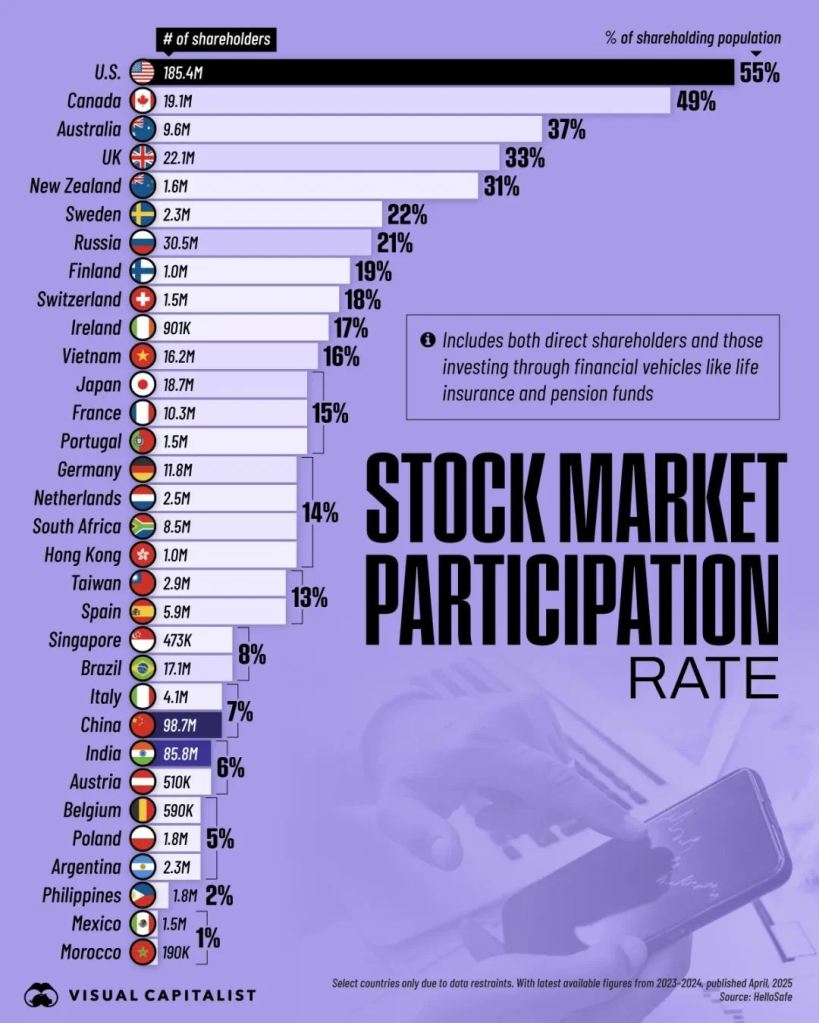
We live in an era where life expectancy is rising, pension systems are shrinking, and inflation quietly erodes the real value of money. In this context, the stock market is one of the most effective tools to preserve purchasing power, protect savings, and build wealth over the long term. And yet, as illustrated by a recent infographic from Visual Capitalist, many countries show an alarmingly low level of participation in the markets.
A Wave Passing Beneath Our Feet
In the United States, more than 55% of the population is exposed to financial markets—whether through direct equity ownership, retirement funds, ETFs, or 401(k) plans. In Canada (49%) and Australia (37%), investing is equally normalized—seen as a responsible, even essential, part of adult life.
In stark contrast, only 7% of Italians invest in stocks. The picture is similarly bleak in India (6%), Brazil (8%), and China (6%). This means the vast majority of citizens in these countries do not benefit from one of the most consistently profitable avenues for long-term growth. For example, the S&P 500 has delivered an average annual return of around 10% over the past 90 years. No savings account or government bond can match this over time.
A Practical Example: What Happens to €10,000 Over Time?
- In a bank account (0% return): In 20 years, it remains €10,000—but inflation will have eaten away 30–40% of its real purchasing power.
- Invested in global equities at a 7% average annual return: It becomes around €38,000.
The difference is staggering. Not investing means standing still while the world moves forward.
Financial Literacy: The Real Divide Between North and South
The true difference between market participants and non-participants isn’t income—it’s culture.
In Anglo-Saxon countries, financial education begins early—often in high school—and is reinforced by systems that empower citizens to take control of their financial futures. In countries like Italy, however, personal finance is virtually absent from school curricula and often taboo at home. As a result, many people view the stock market as a form of gambling, while leaving their money idle in low-yield accounts.
According to the Bank of Italy, only 30% of Italians understand basic financial concepts such as compound interest, inflation, or diversification—well below the OECD average (Bank of Italy – Household Finance Survey, 2023).
Fear of Risk Is the Greatest Risk of All
Ironically, it’s often fear of losing money that prevents people from making money. But today, the greatest financial risk isn’t market volatility—it’s allowing your money to wither away, untouched and unprotected.
Yes, markets fluctuate. There are downturns and crises. But history shows that long-term investors who stay the course typically come out ahead. Even someone who invested right before the 2008 crisis or the 2020 pandemic crash would likely be sitting on substantial gains today. Time, not timing, is the investor’s best friend.
Global Case Studies
- Australia: The mandatory superannuation system—a national retirement fund scheme—has transformed millions into investors. Today, 37% of Australians own stocks.
- Vietnam: Despite modest per capita income, market participation has reached 16%, driven by digital access and strong generational optimism.
- Germany: Traditionally conservative, German households have doubled their investment activity since 2019, largely through ETFs and automated investing platforms.
Investing Is Not Just an Opportunity—It’s a Civic Duty
Investing is not only a personal choice—it’s a collective economic behavior with wide-reaching consequences. The more citizens invest, the more capital flows into businesses, the more resilient the economy becomes, and the less pressure there is on public pensions.
In an era where the welfare state is retreating and financial responsibility is shifting to the individual, the stock market is one of the few remaining tools for economic self-defense.
Conclusion: Investing Is an Act of Freedom
Refusing to invest—whether out of fear, ignorance, or misinformation—is essentially a silent declaration: a resignation to stagnation, a surrender of future potential. This is all the more tragic in a world where low-cost investing tools are accessible and widespread.
Countries like Italy, Brasil and Spain must stop viewing investing as a privilege for the few and start treating it as a right for all. This requires a cultural revolution—starting in classrooms, families, and media. Because to invest, like to work, save, and build, is not just a financial decision. It’s a life choice.

 Rational Wealth