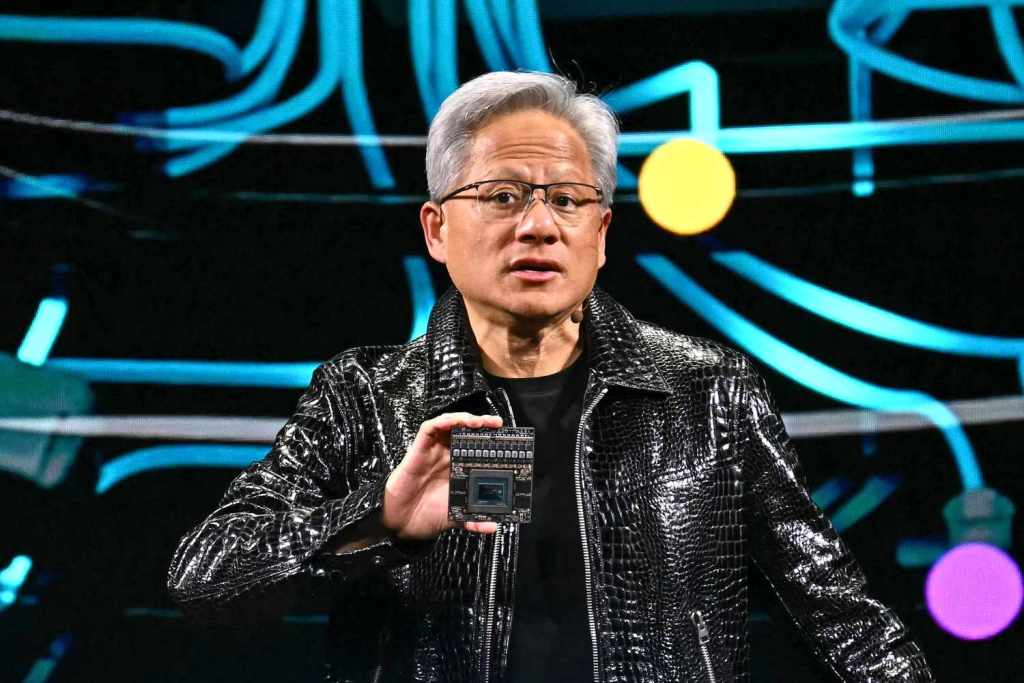
The Nvidia GTC 2025 conference recently came to a close, and as always, it offered an incredible glimpse into the future of technology. The company’s CEO, Jensen Huang, took the stage with his iconic leather jacket to unveil a series of innovations that promise to redefine the landscape of artificial intelligence and high-performance computing. From cutting-edge supercomputers to the power of generative AI, through advanced applications in robotics and gaming, Nvidia is laying the foundation for a true technological revolution. Here is an in-depth analysis of the key innovations unveiled.
Blackwell: The Architecture that Will Change the Game
The crown jewel of GTC 2025 is undoubtedly the introduction of Blackwell, a new architecture designed to push the limits of deep learning and high-performance computing. This technological leap is not just an update but rather a “paradigm shift,” as Huang put it. The new GPUs based on Blackwell promise unprecedented performance, with a speed increase of up to 4 times greater than the previous Hopper generation. But it’s not just about power: energy efficiency has received significant attention, with a 50% reduction in energy consumption, ensuring high performance without waste. This new level of efficiency is especially crucial for the future of data centers and cloud computing, where cost and resource optimization are key to maintaining competitiveness and sustainability.
With Blackwell, Nvidia is not only improving computational power but is also shaping the next generation of AI, particularly in handling increasingly complex artificial intelligence models. The approach taken is to make artificial intelligence not only more powerful but also accessible and scalable for businesses of all sizes.
AI for Everyone: Democratizing Access to Advanced Solutions
One of the main themes that emerged from GTC 2025 was Nvidia’s desire to make artificial intelligence more accessible to businesses of all sizes, including those with fewer resources or less technical expertise. It’s no longer enough to develop powerful hardware; the software must also be simple and scalable. For this reason, Nvidia unveiled significant updates to Nvidia AI Enterprise, its framework for adopting and managing enterprise AI solutions. The most interesting development in this area is the launch of Nvidia NIM, a framework that simplifies the development and deployment of advanced AI models. This platform enables startups and small and medium-sized businesses to leverage the power of AI without the need for deep technical knowledge, dramatically lowering the entry barrier to the world of artificial intelligence.
Generative AI: The Vanguard of Digital Content Creation
The years 2023 and 2024 were pivotal for generative AI, and Nvidia is determined not to be left behind. The company showcased several groundbreaking solutions in the field of automated content generation, particularly in the creation of advanced language models, image and video generation, and real-time creation of hyper-realistic 3D content. Nvidia’s new Omniverse AI system is a platform that enables the generation of ultra-detailed virtual environments with minimal text input, a giant leap towards creating complex and believable digital worlds with an unprecedented level of realism.
This platform not only revolutionizes the metaverse and the gaming industry but also has enormous potential in industrial simulations. Imagine a company that, with a simple prompt, can design virtual environments to test new prototypes or train employees in complex scenarios. Omniverse AI could reduce costs and accelerate the innovation process significantly.
Gaming and Graphics: Advanced Ray Tracing and Upscaling AI
While much of the focus was on AI, Nvidia hasn’t forgotten its gaming enthusiasts. The new Blackwell cards bring significant improvements in advanced ray tracing, delivering superior visual quality and more efficient management of demanding, visually intense games. But the real innovation is the introduction of AI-powered upscaling technology, which allows for smoother images and incredible details even on less powerful hardware. This development will be crucial for players who don’t have high-end gaming PCs, allowing them to enjoy extraordinary visual experiences on more affordable setups.
Additionally, Nvidia’s collaboration with game development studios to integrate the new AI-driven rendering engine could lead to games with unparalleled realism. The result is not only visually stunning but also deeply immersive gaming experiences.
Robotics and Industrial AI: Machines that Learn on Their Own
Another sector Nvidia is aggressively pushing forward is robotics and industrial AI. With the new Isaac AI framework, the company is developing solutions that allow robots to learn autonomously, improving their ability to interact with their environments. This technology has the potential to transform industries such as logistics, manufacturing, and even healthcare, where robots could operate more efficiently and safely.
Thanks to collaborations with leaders in the robotics sector, Nvidia aims to create intelligent machines that can reduce operational costs and optimize efficiency in industrial operations. Self-learning robots could, for instance, be used in production environments to detect anomalies, perform repetitive tasks, or even assist in healthcare.
Supercomputers and Cloud AI: Dominating AI-as-a-Service
Lastly, Nvidia made further strides in the field of cloud computing and supercomputers. With its expanded computational capabilities, the company is preparing to dominate the AI-as-a-Service market, offering businesses the ability to access immense computational power without the need for costly hardware investments. The new solutions for data centers enable companies to leverage the power of Blackwell and other Nvidia technologies to develop advanced AI solutions, reducing costs while increasing flexibility.
Conclusion: A Promising Future for Nvidia and AI
In conclusion, Nvidia GTC 2025 has cemented the company’s position as one of the undisputed leaders in technological innovation, with a particular focus on artificial intelligence. With Blackwell and its new solutions, Nvidia is not only improving computational power but also striving to make AI more accessible and scalable for a broader audience. The applications in gaming, robotics, and supercomputing are evolving at an unprecedented rate, and the growing emphasis on generative AI opens up new frontiers in digital content creation.
While competition in the sector remains fierce, Nvidia appears to have a significant strategic advantage, thanks to a clear vision and cutting-edge technological solutions. As we look to a future increasingly shaped by artificial intelligence, the question now is: how will other industry players respond, and what will Nvidia’s next moves be? The answer to this question will shape the technological landscape for years to come.

 Rational Wealth